
Saudi Arabia is being reshaped at a scale that has never been seen before. At the heart of this transformation lies Vision 2030 construction Saudi Arabia, a national blueprint that was launched in 2016 to diversify the Kingdom’s economy and reduce its reliance on oil revenue. Since then, an extraordinary construction boom has been triggered, and it is now being recognised as one of the largest state-backed development programmes anywhere in the world.
Over $900 billion has been channelled through the Public Investment Fund (PIF) into real estate and infrastructure projects. From the futuristic developments at NEOM to the urban expansion of Riyadh, the construction sector is being positioned as the primary engine of economic growth. For contractors, subcontractors, and infrastructure companies across KSA, this presents a once-in-a-generation opportunity.
In this article, the key ways in which Vision 2030 is driving Saudi Arabia’s construction boom are explored, alongside the major giga projects and construction opportunities that are being created for industry professionals.
Table of Contents
Understanding Vision 2030 and Its Impact on Construction
Vision 2030 was introduced by Crown Prince Mohammed bin Salman as a comprehensive plan to transform Saudi Arabia into a global investment powerhouse. The construction sector was identified early on as a central pillar of this transformation. As a result, massive investments have been directed towards building new cities, expanding transport networks, and developing tourism and entertainment destinations.
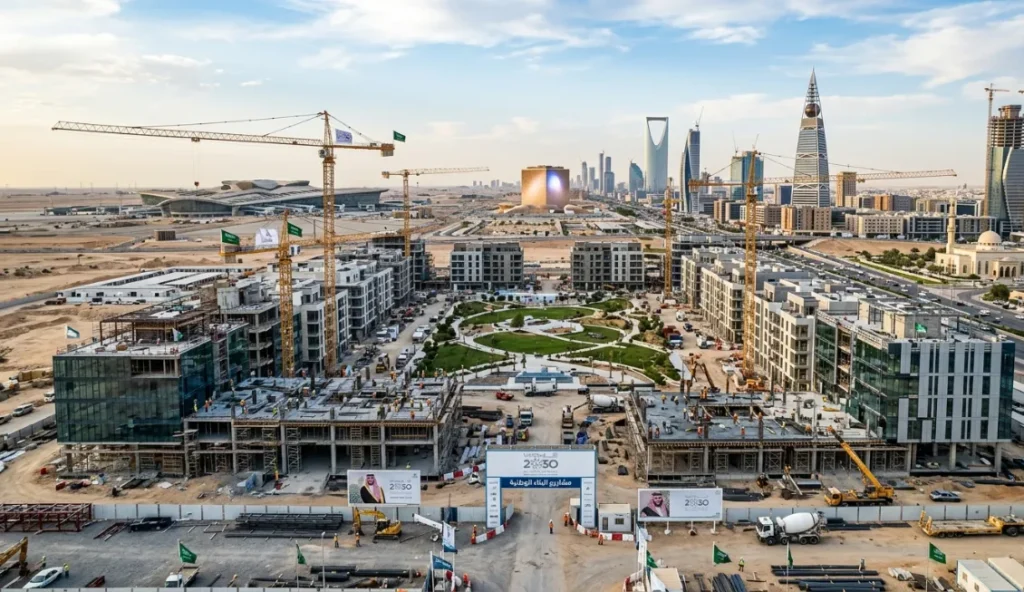
The Kingdom is now expected to become the world’s largest construction market by 2028, with output projected to reach $181.5 billion. This represents a 30% increase compared to 2023. Additionally, the 2025 national budget allocated SAR 1.3 trillion (approximately $342.7 billion) to accelerate infrastructure, housing, and tourism development. It is clear, therefore, that construction is not merely a supporting sector; it is the backbone of Vision 2030.
For any Vision 2030 infrastructure company Saudi Arabia, the message is straightforward. Enormous demand exists for earthworks, enabling works, civil engineering, and specialised structure works across the Kingdom. Companies that are well-positioned, prequalified, and operationally ready will be best placed to capture these opportunities.
The Giga Projects Reshaping Saudi Arabia
The most visible aspect of Vision 2030 construction Saudi Arabia is the portfolio of giga projects that are currently being developed. These are not ordinary developments. They are nation-defining megaprojects designed to attract global investment, create hundreds of thousands of jobs, and redefine the Kingdom’s identity on the world stage.
Here is an overview of the most significant giga projects construction programmes:
| Project | Estimated Value | Key Features | Status (2026) |
| NEOM (The Line, Oxagon, Trojena) | $500 billion+ | Linear city, industrial port, mountain resort | Under review; Oxagon green hydrogen 80% complete |
| Qiddiya Entertainment City | $8 billion+ | Theme parks, sports venues, motorsport facilities | Active construction phase |
| The Red Sea Project | $3.9 billion (2026 phase) | Luxury tourism, 16 modular hotels, marinas | Contracts awarded, delivery by 2028 |
| New Murabba, Riyadh | $50 billion | 104,000 homes, 9,000 hotel rooms, retail and entertainment | Construction ramping up |
| Diriyah Gate | $20 billion+ | Heritage tourism, cultural district, hospitality | Multiple packages under delivery |
| King Salman International Airport | Major infrastructure | 120 million passenger capacity, 8 million m³ earthworks | Under development |
Moreover, preparations for Expo 2030 Riyadh and the FIFA World Cup 2034 are generating additional layers of construction demand. Stadiums, transport links, hospitality infrastructure, and public realm improvements are all being planned and tendered at pace. Consequently, the pipeline of work available for a Vision 2030 contractor Riyadh is substantial and growing.
Riyadh: The Epicentre of Vision 2030 Construction
Whilst giga projects are spread across the Kingdom, it is Riyadh that sits at the epicentre of the Vision 2030 construction programme in Saudi Arabia. The capital city accounts for approximately 40% of the national construction market, and over $200 billion in construction capital was deployed through PIF-backed vehicles between 2023 and 2025 alone.
Several factors are driving the construction surge in Riyadh:
- Residential property values recorded 6 to 8% annual growth in 2026, and rental yields on serviced residences ranged between 4 and 6%.
- The National Housing Company tendered $800 million for 4,500 solar-equipped apartments in early 2026.
- New Murabba alone is expected to absorb 15 to 20% of Riyadh’s existing senior project director capacity.
- Key office district vacancy has been cut to 12%, reflecting strong commercial demand.
- Expo 2030 site construction has commenced, with compliance aligned to new global regulations.
For companies offering earthworks, enabling works, road construction, and manpower supply in the capital, the current environment is exceptionally favourable. As a well-established Vision 2030 contractor Riyadh, firms with prequalification and a strong track record are being actively sought by developers and master planners.
The Growing Need for Subcontractors and Specialist Firms
One of the most important developments within the giga projects construction landscape is the increasing reliance on subcontractors. As projects become larger and more complex, main contractors are seeking specialist partners who can deliver specific scopes of work to the highest standards.
The role of a NEOM subcontractor KSA, for example, involves delivering precise packages of work such as site clearance, temporary facilities, safety infrastructure, piling, earthworks, and civil engineering. Similarly, across Qiddiya, Diriyah Gate, and The Red Sea Project, specialist subcontractors are being engaged for enabling works, structural steel, MEP installations, and landscaping.
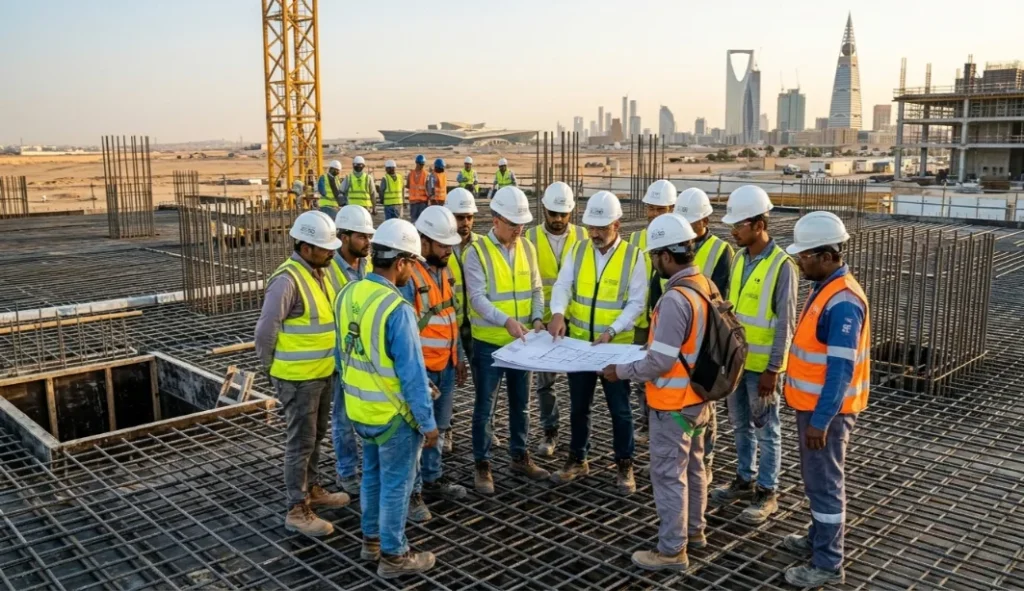
This trend has been further supported by the PIF’s strategy to bring more private sector involvement into project delivery. In 2025, the PIF qualified over 300 Saudi companies to work across its portfolio and integrated more than 200 SMEs into active project pipelines. The local content target reached 60%, which means that opportunities for Saudi-based contractors and subcontractors have expanded significantly.
Furthermore, competition in the market is intensifying as international firms form joint ventures with local contractors. For any Vision 2030 infrastructure company in Saudi Arabia, the ability to demonstrate technical capability, safety compliance, and operational readiness is now more important than ever.
Key Construction Sectors Benefiting from Vision 2030
The breadth of Vision 2030 construction in Saudi Arabia means that opportunities are not limited to a single type of work. Multiple sectors are experiencing strong growth, and each one presents distinct possibilities for contractors and service providers.
| Sector | Growth Driver | Opportunity for Contractors |
| Infrastructure | 36.6% of 2025 market share; transport, power, water | Earthworks, road construction, utility installation |
| Residential | Fastest growth at 6.55% CAGR through 2031 | Housing developments, villa packages, modular builds |
| Commercial | Office, retail, logistics expansion | Fit-outs, structural works, MEP |
| Tourism & Entertainment | 29 opportunities worth SAR 120 billion launched in 2025 | Resort construction, landscaping, public realm |
| Energy & Sustainability | $126 billion grid upgrade; green hydrogen | Renewable energy infrastructure, LEED-certified builds |
As can be seen, the scope of work extends well beyond traditional building construction. Enabling works, site preparation, equipment supply, and manpower provision are all in high demand. Experienced contractors who can offer turnkey solutions are particularly well-positioned.
Technology and Sustainability: The New Standards for Construction
It is worth noting that Vision 2030 construction in Saudi Arabia is not only about scale. It is equally about quality, innovation, and sustainability. By 2026, sustainability will have shifted from being a value-add to a fundamental requirement for all government-backed projects.
New developments are being required to meet strict environmental standards, including reduced carbon emissions, the use of low-impact building materials, enhanced energy and water efficiency, and greater reliance on renewable energy sources. Certifications such as LEED and Mostadam are increasingly demanded, which means contractors must adapt their methods accordingly.
In addition, the adoption of digital construction technologies is accelerating. Building Information Modelling (BIM), digital twins, data analytics, and AI-powered project management tools are becoming standard across major projects. For any Vision 2030 infrastructure company in Saudi Arabia, investing in these capabilities is no longer optional. It is essential.
Modular and 3D-printed construction methods are also being promoted to reduce costs and speed up delivery timelines, particularly in the residential sector. Red Sea Global, for instance, has insisted on modular techniques for its 16-hotel development to minimise environmental impact on surrounding coral reefs.
How FSAK Contracting Supports Vision 2030 Projects
As one of the most trusted construction companies in Riyadh, FSAK Contracting has been actively involved in supporting the Vision 2030 construction programme in Saudi Arabia. With over a decade of experience in earthworks, enabling works, road construction, manpower supply, and special structure works, the company is well-equipped to serve as both a main contractor and a specialist subcontractor for giga-project developments.
FSAK Contracting is prequalified with major Vision 2030 developers and meets all capacity, documentation, and HSE requirements for large-scale projects across KSA. Whether it is site preparation for a new development in Riyadh, enabling works for infrastructure projects, or providing skilled manpower to meet tight deadlines, the team delivers results on time, within budget, and to international standards.
For those searching for a reliable Vision 2030 contractor in Riyadh or a capable NEOM subcontractor in KSA, FSAK Contracting offers the experience, workforce, and operational capability to take on projects of any size and complexity.
Frequently Asked Questions
1. What is the role of Vision 2030 in Saudi Arabia’s construction sector?
Vision 2030 has been designed to diversify the Kingdom’s economy, and the construction sector has been placed at the centre of this transformation. Over $1.25 trillion worth of projects have been planned across infrastructure, tourism, housing, and entertainment. As a result, the demand for contractors, subcontractors, and infrastructure companies has increased substantially.
2. Which are the biggest giga projects construction programmes under Vision 2030?
The largest giga projects include NEOM (encompassing The Line, Oxagon, and Trojena), Qiddiya Entertainment City, The Red Sea Project, New Murabba in Riyadh, Diriyah Gate, and King Salman International Airport. Each of these requires extensive earthworks, civil engineering, and specialist construction services.
3. How can a contractor become a Vision 2030 contractor in Riyadh?
To participate in Vision 2030 projects, contractors are typically required to be prequalified with relevant developers and government entities. This involves meeting strict capacity, documentation, HSE, and technical standards. Firms with proven experience in earthworks, enabling works, and large-scale project delivery are preferred. Registration through MISA portals and alignment with Saudisation requirements are also important.
4. What opportunities exist for a NEOM subcontractor KSA?
NEOM and other giga projects are increasingly relying on specialist subcontractors for specific packages of work, including site clearance, piling, earthworks, temporary facilities, structural steel, and civil engineering. The PIF has also been actively qualifying Saudi companies to work across its portfolio, creating significant opportunities for local firms.
5. Why is sustainability important in Vision 2030 construction in Saudi Arabia?
Sustainability is now a mandatory requirement for all government-backed projects under Vision 2030. Contractors are expected to adopt eco-friendly practices, use low-impact materials, and meet certifications such as LEED and Mostadam. Projects like The Red Sea development have specifically required modular construction techniques to protect the natural environment. Firms that can demonstrate sustainable practices will be given priority in contract awards.
Ready to Partner with a Trusted Vision 2030 Contractor?
FSAK Contracting is one of Saudi Arabia’s most experienced construction companies, delivering earthworks, enabling works, road construction, and manpower supply across Riyadh and KSA. To discuss your project requirements and explore how we can support your Vision 2030 development, contact us today for a free consultation.