
Every Saudi contractor faces the same decision sooner or later: do we buy this excavator, loader, or tower crane — or do we rent it? On paper, ownership looks cheaper. In the field, the answer is rarely that simple.
The rent or buy construction equipment Saudi Arabia question hides a long tail of costs that contractors routinely underestimate: dust-driven maintenance cycles, Saudization quotas on operators, idle time between projects, mobilisation across long distances to giga-project sites, and the brutal effect of KSA’s climate on hydraulic systems and resale value.
This guide breaks the decision down the way a 20+ year Saudi construction contractor actually thinks about it — not from a sales angle, but from the procurement spreadsheet.
Table of Contents
Why the Rent-or-Buy Decision Is Different in Saudi Arabia
Three things make the KSA market unlike anywhere else for equipment economics:
- Project geography is enormous. A Riyadh-based contractor mobilising to NEOM, Trojena, or the Red Sea Project can spend more on transport and accommodation than on the equipment itself for short jobs.
- Operating conditions are aggressive. Heat, dust, and long shift cycles compress equipment life and inflate maintenance intervals.
- Project pipelines are uneven. Vision 2030 has created concentrated booms in specific zones, leaving owned fleets idle elsewhere — and idle equipment is the most expensive kind.
If you ignore any of these three, the rent-vs-buy maths will lie to you.
The True Cost of Owning Construction Equipment in KSA
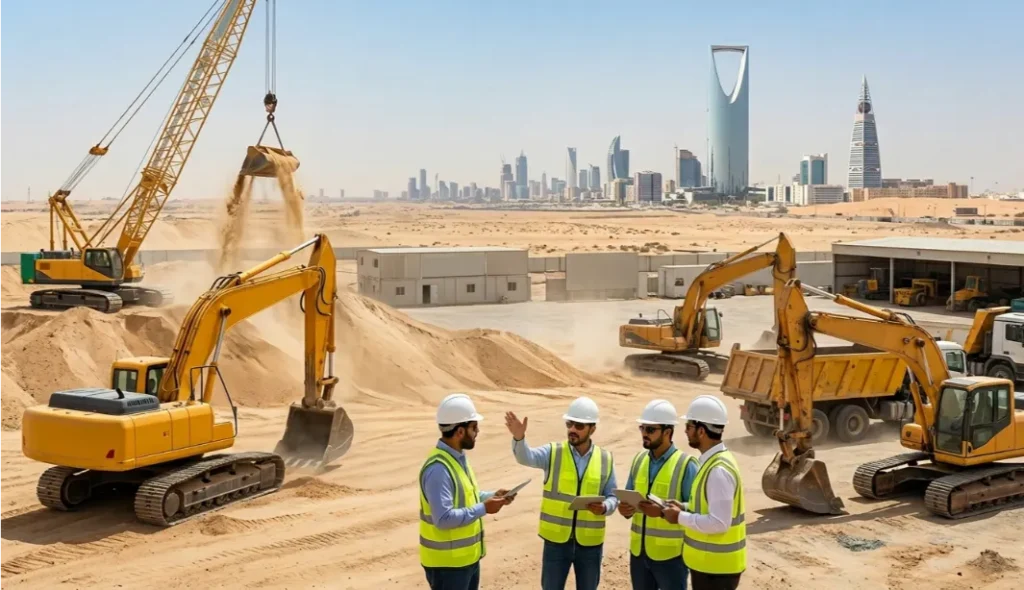
The biggest mistake contractors make is comparing the rental rate vs. the purchase price. That’s not the right comparison. The right comparison is rental rate vs Total Cost of Ownership (TCO) per operating hour.
Here’s what actually goes into TCO.
1. The Acquisition Cost Is Just the Down Payment on a Decade
The purchase price is the visible number. The invisible numbers — financing, registration, import duties on certain models, and the opportunity cost of locked capital — add a meaningful percentage on top before the machine has turned a wheel.
2. Maintenance in Saudi Conditions Is Higher Than the Brochure
Manufacturer maintenance schedules assume European or North American conditions. In KSA, expect:
- Shorter filter intervals because of fine airborne dust
- Faster hydraulic seal wear under sustained 45°C+ ambient operation
- More frequent cooling-system flushes
- Higher tyre and undercarriage wear on abrasive aggregates
A reasonable planning figure is annual maintenance running roughly 10–15% of asset value, sometimes higher for heavy-duty machines on continuous operation. Contractors who budget the OEM number are usually short by year two.
3. Operators, Saudization, and Iqama Overhead
Equipment doesn’t operate itself. Every owned machine carries:
- Certified operator salary (and the certification cost itself)
- Iqama/visa processing for expatriate operators
- Accommodation and transport
- Saudization compliance overhead on your wage bill
- Coverage operators for leave and rotation
Rental arrangements with operator included roll most of this into the daily rate. Owners absorb it whether the machine works that month or not.
4. Storage, Insurance, and Site Transport
An owned fleet needs a yard, secure perimeter, fuelling area, basic workshop, and inventory of spares. Insurance is annual, whether the machine is working or parked. Mobilising heavy equipment from Riyadh to NEOM, Jubail, or Yanbu involves lowbed transport, escort logistics, and permits — each move adds non-trivial cost that rental companies typically include or split for short-term jobs.
5. Depreciation and Resale in the KSA Market
A piece of yellow iron operating in Saudi conditions does not hold its value the way the same model would in a milder climate. Hours accumulate fast, undercarriages and engines show wear earlier, and the secondary market discounts accordingly. A realistic 5-year resale assumption in KSA is meaningfully lower than the brochure depreciation curve suggests.
The Real Cost of Renting Equipment in KSA
Rental looks expensive on a daily rate. On a monthly or quarterly basis, especially with included services, the gap closes fast — and on idle time, rental always wins because there is no idle time.
What a Rental Rate Usually Includes
A reputable equipment rental supplier in Saudi Arabia will typically include:
- Certified operator (where required)
- Routine maintenance and breakdown response
- Insurance on the asset
- Mobilisation within an agreed radius
- Backup unit availability for critical-path work
What It Often Doesn’t Include
Watch for:
- Fuel
- Long-distance mobilisation to remote giga-project sites
- Operator accommodation on remote camps
- Standby/waiting time charges
- Overtime hours beyond a standard shift
Read the rental agreement the same way you’d read a tender — line by line. The cheapest daily rate is rarely the cheapest delivered cost.
A Common Costly Mistake We See on Saudi Sites
A common pattern across the Saudi market goes like this:
A growing mid-market contractor wins a 14-month infrastructure package and decides to buy three excavators, two wheel loaders, and a fleet of dump trucks to “save on rental.” The capital outlay is sizeable, financing is arranged, and operators are hired.
The project finishes in month 12 — a month early, which is good news. But the next contract doesn’t start for five months. During that gap:
- The machines sit in a yard accruing insurance and depreciation
- Operators are still on payroll (releasing and rehiring certified operators in KSA is harder and slower than most assume)
- A hydraulic issue on one excavator goes undiagnosed because no one is running it daily
- When the next project mobilises, two of the six machines need workshop time before they can go to the site, delaying the start
By the time the contractor runs the numbers honestly, the “savings” from buying have been eaten by idle months, surprise repairs, and a delayed second-project start. A blended rent-buy strategy — owning only the machines used continuously across multiple projects, and renting the rest — would have left them with stronger cash flow and the same delivery capacity.
This pattern repeats more often than the industry admits.
When Buying Equipment Makes Sense
Ownership is the right call when all of the following are true:
- Utilisation will realistically exceed roughly 70–75% across the next 3–5 years
- The equipment type is a core, repeated need across your project pipeline
- You have in-house workshop capability and certified operators already on payroll
- Cash flow can absorb the CAPEX without straining tender bonds or working capital
- The asset type holds value reasonably well in the KSA secondary market
Typical “buy” candidates for an established Saudi contractor are core earthworks machines used continuously, dump trucks for a stable internal haulage need, and specialised assets that justify long-term mastery.
When Renting Wins Every Time
Renting is almost always the better answer when:
- The equipment is needed for a single project or a defined contract duration
- Utilisation will be patchy or under 50% across the year
- The work site is remote (NEOM, Trojena, Red Sea, Amaala), and mobilisation logistics are heavier than the rental premium
- You need a specialised machine — a concrete pump, a large crawler crane, an asphalt paver — for a defined phase
- Cash flow is better deployed in tender bonds, performance guarantees, or scaling the team
- You want operator, maintenance, and breakdown risk transferred to the rental provider
If you are scaling on the back of Vision 2030 contracts, preserving working capital is usually worth more than the theoretical long-run savings of ownership.
The Vision 2030 and Giga-Project Factor
Giga-projects change the calculation in ways that don’t show up in standard TCO templates.
- Mobilisation distances are enormous. Moving an owned fleet from Riyadh to NEOM, Trojena, or the Red Sea Project is a logistical project in itself. Rental providers closer to those zones often beat the delivered cost of owned equipment.
- Project phases are sharply defined. Earthworks, then enabling works, then road and utility works, then structures, then landscaping — each phase requires different equipment, and few owners can efficiently match their fleet to every phase.
- HSE and compliance standards on giga-projects are demanding. Newer rental fleets with current certifications and operator credentials can clear pre-mobilisation audits faster than older owned machines.
- Contract durations can shift. Giga-project schedules are fluid. Rental flexibility absorbs that risk; ownership doesn’t.
For contractors targeting NEOM, Qiddiya, Diriyah Gate, Roshn, or King Salman Park works, a rental-led or hybrid fleet strategy almost always outperforms a pure-ownership model — at least until the contract pipeline in that specific zone is locked in for multiple years.
A Simple Framework for Your Next Equipment Decision
Before signing a purchase order or a rental agreement, run this five-question test:
- How many billable hours will this machine actually work over the next 24 months? Be honest. Halve the optimistic answer.
- What’s the delivered cost per hour under ownership vs rental? Include maintenance, operator, insurance, storage, mobilisation, and idle months.
- What happens to the asset between projects? If the answer is “we’ll figure it out,” rent it.
- What’s the cash flow alternative? Could that capital fund another tender bond, a second crew, or a larger contract bid?
- What’s the downside risk? If the next contract is delayed by six months, can you absorb it as a rental cost or as an idle-fleet cost?
If the honest answers point toward owning the machine, buy it. If they point toward renting, rent it. Most of the time, the answer for KSA contractors in growth mode is a blended fleet: own the workhorses, rent everything else.
Frequently Asked Questions
Is it cheaper to rent or buy heavy equipment in Saudi Arabia?
It depends on utilisation. If a machine will be used more than roughly 70–75% of the time across multiple years, and you have the workshop capability to maintain it, buying usually wins on cost per hour. Below that, or on single-project deployments, renting almost always delivers a lower delivered cost once idle time, mobilisation, and maintenance are included.
What hidden costs do Saudi contractors underestimate when buying equipment?
The most commonly missed costs are dust- and heat-driven maintenance intervals, certified operator costs including iqama and accommodation, insurance and storage during idle months, long-distance mobilisation to giga-project sites, and lower-than-expected resale value after years of operation in KSA conditions.
Does renting equipment work for giga-projects like NEOM and Trojena?
Yes. For most contractors, renting through a Saudi supplier with mobilisation capability is more practical than transporting an owned fleet across the country. Project phases on giga-projects shift quickly, and rental flexibility absorbs that risk better than ownership.
What’s the typical utilisation rate where buying becomes worth it?
Around 70–75% utilisation across a 3–5 year horizon is the usual breakpoint, assuming you also have in-house operators and maintenance capacity. Below that, rental usually beats ownership on total cost per operating hour.
Can I rent equipment with operators in Saudi Arabia?
Yes. Most reputable Saudi equipment rental providers offer operated rental, including certified operators, routine maintenance, and breakdown response. This shifts compliance and HSE responsibilities to the rental provider and removes Saudization overhead from your payroll for that machine.
Should new contractors in KSA buy or rent equipment first?
For new and growing contractors, renting almost always makes more sense. It preserves working capital for tender bonds and performance guarantees, avoids locking capital into depreciating assets before utilisation is proven, and lets the business scale without carrying idle-fleet cost during gaps between contracts.
Request an Equipment Rental Quote
If you’re weighing whether to rent or buy for an upcoming Saudi project, the smartest first step is to price the rental side accurately before committing to ownership. FSAK Contracting operates its own equipment fleet across Saudi Arabia and rents to contractors working on Vision 2030 projects, infrastructure programs, and private developments.
Request an equipment rental quote — share your project scope, location, and duration, and our team will return a delivered-cost quotation including operators where required.