Riyadh is currently home to one of the largest concentrations of construction activity anywhere in the world. Billions of riyals are being invested across residential, commercial, transport, entertainment, and utility projects, all driven by the Vision 2030 programme and the ambition to grow the capital’s population to 15 million by 2030. For contractors, developers, suppliers, and procurement teams operating in Saudi Arabia, understanding which construction projects in Riyadh are active, which are in the pipeline, and what type of contracting work each one requires is essential for planning bids, mobilising resources, and securing subcontract opportunities.
This guide covers the most significant active and upcoming construction projects in Riyadh, grouped by status. It is written for the professionals who build these projects, not just the people who read about them.
Table of Contents
Why Riyadh’s 2026 Construction Boom Matters to Contractors
Behind every glossy render sits an enormous volume of unglamorous work. Before towers rise, sites must be cleared, levelled, drained, and serviced. Consequently, the headline projects below are powered by earthworks, utility lines, access roads, and thousands of skilled workers. For a Riyadh-based contractor, this pipeline represents years of subcontracting, supply, and rental opportunities. Moreover, much of this activity is driven by the Public Investment Fund and aligned with Vision 2030 infrastructure goals in KSA, which gives the work both scale and stability.
The Riyadh Metro and the Line 7 Expansion
Riyadh accounts for a disproportionate share of Saudi Arabia’s total construction spend. Several factors drive this. The Royal Commission for Riyadh City (RCRC) is overseeing a transformation programme that touches almost every sector: transport, housing, leisure, culture, green space, and digital infrastructure. Corporate headquarters relocations, driven by the government’s requirement for regional headquarters to be based in the capital, have created a secondary wave of commercial real estate and office tower construction. Population growth targets require hundreds of thousands of new residential units within the next five years.
The result is a construction market where civil contractors, earth and enabling works companies, manpower suppliers, equipment rental providers, road builders, and utility installation specialists all face sustained demand. The pipeline is not a single mega-project but a network of interdependent developments, each requiring its own supply chain of contractors and subcontractors.
Major Construction Projects in Riyadh
These are the flagship developments that define Riyadh’s current construction landscape. Each involves multi-year timelines, multiple contractor tiers, and a wide range of civil and infrastructure works.
King Salman Park: The World’s Largest Urban Park
King Salman Park is being created on the grounds of Riyadh’s former airport, covering about 16.9 square kilometres. Set to become the largest urban park in the world, the development carries an estimated value of SAR 72 billion. So far, more than 13 million cubic metres of soil have been excavated, and roughly one million trees are planned across the site.
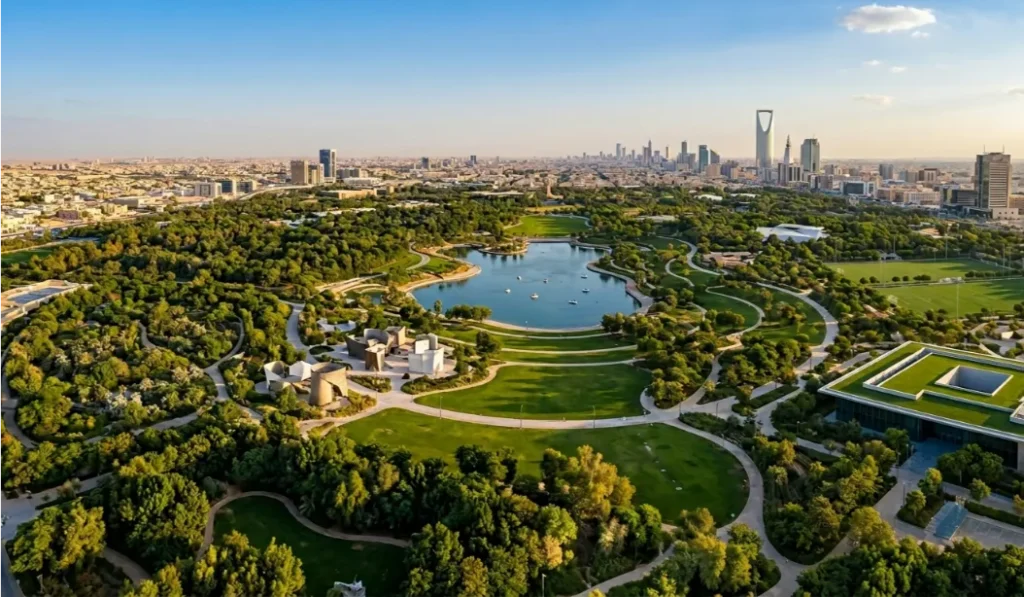
Furthermore, the park is being built as a transit-oriented destination linked to several metro stations. For contractors, the appeal lies in the supporting works, including tunnels, bridges, irrigation networks, and large-scale landscaping. Initial phases are expected to open in late 2026, with wider completion targeted for 2027.
New Murabba and the Mukaab: A Project Being Recalibrated
New Murabba is planned as a new downtown district in northwest Riyadh, anchored by the Mukaab, a 400-metre cube-shaped structure that will house immersive entertainment, hospitality, and commercial space. The surrounding district covers approximately 19 square kilometres and will include over 100,000 residential units, retail areas, and leisure facilities. From a construction perspective, the project demands enabling works at an enormous scale, including excavation, site levelling, temporary works, and access road construction. Utility installation for water, sewerage, electrical, and telecommunications is a major workstream, alongside road construction and landscape works for the public realm.
Diriyah Gate
Diriyah Gate is a heritage-led, tourism-focused development on the outskirts of Riyadh at the historic site of the first Saudi state. The project includes luxury hotels, a cultural quarter, museums, retail souks, residential villas, and extensive public realm works designed in Najdi architectural style. Construction works include careful earthworks around the UNESCO-listed At-Turaif district, landscape installation for public gardens and wadis, road and pedestrian pathway construction, and utility infrastructure. The project requires contractors with experience in sensitive site conditions and heritage-adjacent construction, alongside standard civil works capability.
Sports Boulevard
Sports Boulevard is a 135-kilometre linear park and urban corridor running through Riyadh, connecting the Wadi Hanifah in the west to the Wadi Al-Sulai in the east. The project includes cycling tracks, pedestrian pathways, sports facilities, retail nodes, and green corridor works. Construction encompasses earthworks for pathway grading and terrain modification, landscape installation at a city-wide scale, road crossings and bridge structures, lighting and irrigation systems, and utility diversions where the boulevard intersects existing infrastructure. For civil contractors, manpower suppliers, and equipment rental companies, Sports Boulevard represents one of the longest continuous construction programmes in the city.
King Khalid International Airport Expansion
King Khalid International Airport (KKIA) is undergoing expansion to increase capacity in line with Riyadh’s population and tourism growth targets. Works include new terminal construction, runway upgrades, apron expansion, taxiway modifications, and landside infrastructure including access roads, car parks, and utility connections. The airport programme requires earthworks for site preparation, road construction for new access routes, utility installation for power, water, and fuel systems, and specialist structural works. Manpower supply for airport construction is subject to additional security clearance and compliance requirements.
Roads, Utilities, and the Enabling Works Behind the Headlines
While the giga projects attract attention, the quieter backbone work is equally significant. In 2024, road infrastructure contracts worth around SAR 13 billion were awarded under the Main and Ring Roads Development Programme, and the city’s green corridors continue to expand. The table below summarises the contractor-relevant scope across these flagship developments.
| Project | Scale | Key Contractor Scope |
|---|---|---|
| Riyadh Metro Line 7 | ~65 km, 19 stations | Excavation, tunnelling, utilities, stations |
| King Salman Park | 16.9 sq km | Earthworks, landscaping, irrigation, bridges |
| New Murabba | 19 sq km | Site preparation, utilities, road construction |
| Main and Ring Roads | SAR 13 billion phase | Asphalt, grading, drainage, signage |
What do these Riyadh Mega Projects 2026 Mean for Contractors
The scale and variety of construction projects in Riyadh create specific demands across the contractor supply chain. Earthworks and enabling works contractors are needed at the front end of every major development for site clearance, excavation, grading, and temporary works. Road construction companies are required for both internal development roads and citywide network expansion.
Manpower supply companies face demand for skilled and unskilled labour across all project types, from labourers and operators to welders, electricians, and carpenters. Equipment rental providers are supplying excavators, loaders, graders, cranes, and compactors to projects that need fleet capacity without capital commitment. Utility installation contractors are required on every project that connects to municipal water, sewerage, and electrical networks. Landscape contractors are in demand across the green programme, mega-projects with public realm components, and residential community developments.
For contractors looking to enter or expand in the Riyadh market, the key is matching your service capability to the right tier of project and the right stage of procurement. Pre-qualification requirements vary significantly between giga-project packages and municipal utility contracts.
How FSAK Contracting Supports Riyadh’s Construction Pipeline
FSAK Contracting is a Riyadh-headquartered construction contractor with over 20 years of operational experience across Saudi Arabia. The company delivers earth and enabling works, manpower supply and management, road construction, landscape works, equipment rental, utility installation, and special structures from its base on An Nasr Road, Al-Masani’. FSAK operates its own modern equipment fleet, which means projects are not dependent on third-party rental availability or scheduling.
For developers, main contractors, and project owners working on Riyadh’s current and upcoming construction projects, FSAK provides the type of contractor that can mobilise quickly, scale manpower to match project phases, and deliver civil works on time and within budget. Whether the requirement is site preparation for a new residential community, earthworks for a mega-project, road construction for a district masterplan, or manpower supply for a commercial tower programme, FSAK’s service scope covers the core contracting disciplines that Riyadh’s construction pipeline demands.
To discuss a project requirement, request a quotation, or arrange a site visit, contact the FSAK project team directly.
Frequently Asked Questions
Q1: How many major construction projects are currently active in Riyadh?
Riyadh has dozens of major construction projects active simultaneously, including King Salman Park, New Murabba, Diriyah Gate, Sports Boulevard, ROSHN residential communities, KKIA expansion, and ongoing road and utility infrastructure programmes. The total investment across these projects runs into hundreds of billions of riyals.
Q2: What types of contractors are in demand for Riyadh construction projects?
Earthworks and enabling works contractors, road construction companies, manpower supply firms, equipment rental providers, utility installation contractors, and landscape specialists are all in sustained demand. Each major development requires multiple contractor tiers, from main contractors to specialist subcontractors.
Q3: Are there upcoming construction projects in Riyadh expected to start in 2025 and 2026?
Yes. New phases of ROSHN communities, Riyadh Metro feeder routes, Riyadh Green programme sites, and KAFD Phase 2 works are all expected to move into procurement and early works stages. Ongoing road and utility expansion programmes also release new tender packages regularly.
Q4: How can a contractor get involved in Riyadh’s mega-projects?
Contractors typically need to complete pre-qualification processes with the relevant project authority or main contractor. Requirements vary by project scale but generally include proof of financial capacity, equipment fleet, workforce capability, safety record, and relevant project experience in Saudi Arabia.
Q5: Does FSAK Contracting work on construction projects in Riyadh?
FSAK Contracting is headquartered in Riyadh and delivers earthworks, manpower supply, road construction, landscape works, equipment rental, and utility installation across the city. The company has over 20 years of operational experience and operates its own equipment fleet.
Q6: What is the estimated timeline for Riyadh’s Vision 2030 construction projects?
Most of Riyadh’s flagship Vision 2030 projects have phased delivery timelines extending from 2025 through 2030 and beyond. Some, like King Salman Park and Diriyah Gate, have early phases already completed with later phases still in construction. Others, like New Murabba, are in earlier stages of enabling works and will continue for several years.