Site preparation is consistently the most underestimated phase of any construction project in Saudi Arabia. Compress it, skip steps, or treat it as a formality — and you inherit delays, cost overruns, structural failures, and HSE incidents before a single permanent column is cast. Get it right, and the entire project flows on schedule.
This guide sets out the essential site preparation steps that every serious contractor follows on Saudi projects — whether that is a residential compound in Riyadh, an industrial facility in Jubail, or a component of a Vision 2030 giga-project in Tabuk or NEOM.
Table of Contents
Why Site Preparation Is Critical in the Saudi Construction Environment
Saudi Arabia’s built environment presents conditions that make thorough site preparation non-negotiable. Extreme heat, loose aeolian (wind-deposited) sand, sabkha soils prone to collapse or expansion, seasonal groundwater shifts, and the pace of Vision 2030 delivery timelines leave no room for poorly assessed ground conditions or missing regulatory clearances.
Skipping or compressing site preparation is a primary cause of:
- Structural failures traced back to under-assessed bearing capacity
- Cost escalation when utilities are discovered mid-excavation
- HSE incidents from uncontrolled site access or unmarked hazards
- Regulatory shutdowns for permits not obtained before work commenced
- Project delays caused by subgrade compaction failures that require remediation
For government bodies, developers, and EPC main contractors, the site preparation methodology presented in a tender submission by construction contractors in Riyadh is evaluated as a qualification filter, not simply as background.
Step 1 — Site Survey and Geotechnical Investigation
Every compliant Saudi construction project begins with a verified topographic survey and a geotechnical investigation (soil study). A geotechnical investigation is the scientific assessment of a site’s ground conditions — soil type, bearing capacity, water table, and stability- that engineers use to design safe foundations. Saudi Building Code (SBC) Section 303 mandates geotechnical reports for most structural projects, and no credible structural engineer will finalise a foundation design without one.
The topographic survey establishes existing boundary dimensions, levels, setbacks, and the positions of any existing utilities on or adjacent to the site.
What the Geotechnical Report Must Cover
A compliant geotechnical investigation in Saudi Arabia must determine:
- Soil classification and bearing capacity at the design foundation depth
- Presence and extent of sabkha soils — expansive or collapsible ground common in Riyadh’s central and eastern corridors and across coastal zones
- Groundwater depth and seasonal variation
- Chemical aggressiveness of soils and groundwater (sulphate content matters in concrete mix design)
- Recommended foundation type and depth based on load conditions
This data feeds directly into the foundation and earthworks specification — and shapes the BOQ for the entire enabling works package.
Step 2 — Permits, Approvals, and Regulatory Clearance
No physical works should commence on a Saudi construction site without the required permits confirmed in writing. Attempting to fast-track this step routinely results in stop-work orders from Amanah (the relevant municipal authority), fines, and delays that far exceed any time saved.
Required approvals before site preparation begins typically include:
- Building permit from the municipal authority (Amanah)
- Drawing approvals from the Saudi Council of Engineers (SCE)
- Environmental clearance for sites near wadis, coastal zones, or protected areas
- Road closure or access permits where the site impacts public highways
- Utility authority notifications to Marafiq, SEC, STC, or regional water companies
- SASO materials compliance confirmation, where relevant
For giga-project sites — NEOM, Qiddiya, The Red Sea Project, and Diriyah Gate — additional operator-level programme approvals apply before any contractor mobilises. FSAK’s team supports clients with permit coordination as part of the site preparation and enabling works package.
Step 3 — Land Clearing and Demolition of Existing Structures
Once permits are confirmed, physical work begins with land clearing. In Saudi Arabia, this scope varies significantly by location and land history:
- Vegetation and root system removal (common in agricultural areas such as Al-Kharj, Hofuf, and Al-Ula)
- Demolition of existing structures — abandoned buildings, old boundary walls, temporary compounds
- Removal or capping of legacy utility connections
- Rock breaking in elevated terrain (Taif, Abha, and Hail escarpments)
- Clearing of construction debris or contaminated fill from previously developed plots
Waste disposal must follow Saudi municipal solid waste regulations. Unlicensed tipping of demolition material is both a regulatory and reputational risk for project owners, and is not a practice FSAK adopts.
Step 4 — Excavation and Bulk Earthworks
With the site cleared, excavation begins. The scope depends on project type and structural design:
- Mass excavation to the formation level for raft foundations, basement slabs, and large platform areas
- Trench excavation for strip footings, pad foundations, and utility corridor pre-installation
- Cut and fill operations to balance earthwork volumes across sloped sites and minimise imported or exported material
- Rock excavation by mechanical breaking or controlled blasting, where hard rock appears at shallow depth
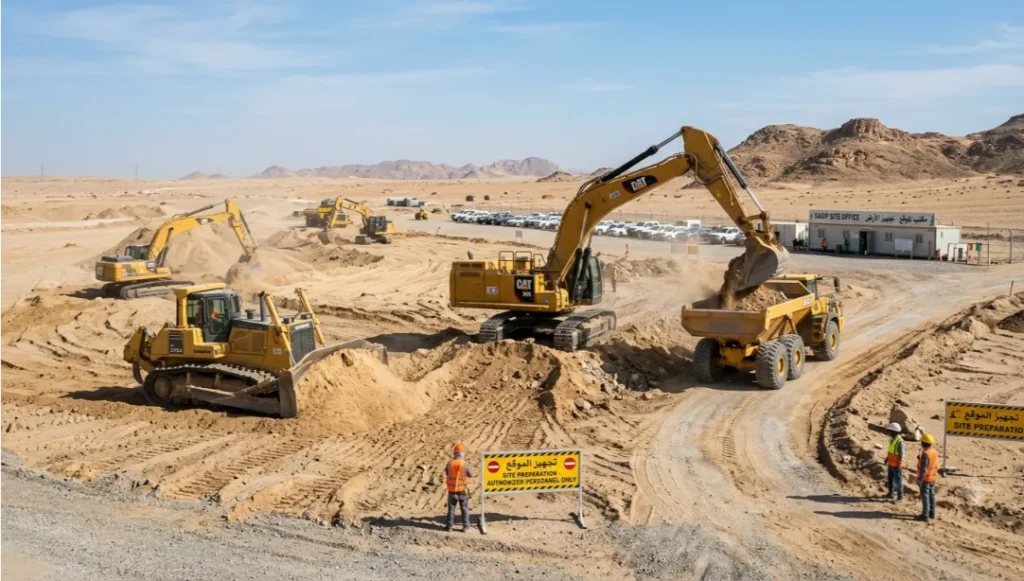
FSAK operates its own fleet of excavators, bulldozers, and articulated dump trucks — so excavation programmes run without third-party equipment dependency. On time-sensitive projects, this matters.
Step 5 — Grading, Compaction, and Subgrade Preparation
Raw excavated ground is not ready for construction. Grading and compaction establish the engineered platform that every subsequent trade depends on:
- Fine grading to precise formation levels as set by the topographic survey
- Compaction of subgrade soils to specified density ratios (typically 95–98% Modified Proctor, zone-dependent)
- Import and placement of granular fill or crusher run where native soils are unsuitable — sabkha soils routinely require full removal and replacement with engineered fill
- Proof-rolling and field density tests to confirm compaction compliance before concrete works commence
- Sub-base installation for slabs, internal pavements, and hard-standing areas
Compaction failure is among the most common causes of slab cracking and structural settlement in Saudi Arabia. It is also among the easiest failures to prevent with correct specification and supervision.
In FSAK’s experience across Riyadh sites, sabkha soils requiring full excavation and engineered fill replacement are encountered on approximately 1 in 4 plots in the city’s eastern and southern zones — most frequently in areas between Al-Kharj Road and the old airport corridor.
Step 6 — Temporary Facilities and Site Infrastructure
Before the main construction workforce arrives, the site must function as a managed, legal construction environment. This step is often underbudgeted and underestimated:
- Perimeter hoarding and controlled access points with security
- Temporary site offices, welfare facilities, and material storage areas
- Temporary power supply (SEC connection or generator)
- Temporary water supply and sanitation
- Internal haul roads and hard-standing areas for equipment movement
- Temporary drainage and dust suppression systems (dust control is legally required across most Saudi municipalities)
- Site signage, HSE notices, and emergency assembly points displayed in Arabic and English
These temporary works are not optional. They are legally required under Saudi municipal regulations and are contractually expected by most government, developer, and EPC clients.
Step 7 — Enabling Works and Pre-Construction Coordination
The final stage of site preparation bridges to the start of permanent construction:
- Pre-installation of underground utility ducts and sleeves beneath slab zones, before concrete is poured
- Preparation of test pile platforms and access for foundation testing engineers
- Topsoil stripping and stockpiling for later landscaping reinstatement
- Coordination with Marafiq, SEC, and STC for permanent utility service connections
- Final survey check to verify all levels, boundaries, and setbacks match approved municipal drawings
A well-delivered enabling works package hands the structural contractor a clean, compliant, and fully prepared site — reducing their programme risk from day one.
How FSAK Contracting Delivers Site Preparation Across Saudi Arabia
FSAK Contracting is an established construction contractor in Riyadh, delivering site preparation and enabling works across Riyadh and major Saudi cities for over 20 years. We work directly with government bodies, real estate developers, industrial clients, and EPC main contractors across the Kingdom.
Our site preparation scope covers the complete sequence: topographic and geotechnical coordination, municipal permit management support, land clearing and demolition, mass and trench excavation, grading, compaction and subbase, temporary facilities construction, and enabling works. All operations are managed in accordance with a documented HSE plan by qualified site supervisors.
FAQs
Q1: How long does site preparation typically take on a Saudi construction project?
Timeline depends on site area, existing conditions, and permit processing speed. A clean, previously undeveloped Riyadh plot of 2,000–5,000 m² can be survey-confirmed, cleared, excavated, and compacted within 3–6 weeks once permits are issued. Larger sites with existing structures, sabkha remediation requirements, or utility diversions typically run 8–16 weeks. Permit lead times from Amanah vary — factor 2–4 weeks minimum for standard projects.
Q2: What happens if sabkha soil is found during the site investigation?
Sabkha soils must be fully excavated and replaced with compacted engineered fill to a depth and specification confirmed by a licensed geotechnical engineer. There is no compliant shortcut. The volume of removal and fill replacement is calculated from the geotechnical report and priced in the earthworks BOQ before construction begins.
Q3: Do I need a geotechnical report even for a small residential build in Riyadh?
For most structural projects in Saudi Arabia, the Saudi Building Code (SBC) Section 303 requires a geotechnical investigation before foundation design is finalised. Even for smaller residential projects, an investigation is strongly advised — particularly across Riyadh’s eastern and southern zones, where sabkha and loose fill deposits are not always visible at the surface level.
Q4: Can site preparation and main construction mobilisation overlap?
In some cases, enabling works zones on large sites can be handed over progressively — allowing foundation works to commence in completed areas while preparation continues elsewhere. This requires careful programme sequencing and site logistics coordination. FSAK advises clients on phased handover strategies where programme compression is a project requirement.
Q5: What does a site preparation BOQ typically include?
A site preparation BOQ in Saudi Arabia typically covers: topographic and geotechnical investigation fees, demolition and clearance, mass excavation and haulage, engineered fill supply and compaction, grading to formation, subbase installation, temporary facilities construction, and enabling works including utility pre-installation sleeves and pile test platforms.
Planning a construction project in Saudi Arabia? FSAK Contracting delivers complete site preparation and enabling works — from initial survey to handover-ready formation level. Book a Free Site Assessment or call +966 50 248 5888 to speak with the project team directly.
Need excavation and earthworks for your Saudi project? View FSAK’s Earth and Enabling Works service to see full scope and equipment.