Construction safety standards in Saudi Arabia are set by several bodies, mainly the Ministry of Human Resources and Social Development (MHRSD), the national OSH framework, Civil Defense, and the Saudi Building Code. Together, they cover worker protection, fire safety, site setup, and equipment use. Since 1 July 2025, the updated 2024 Saudi Building Code has been mandatory, and most established contractors also run their safety systems to the ISO 45001 international standard.
The short version is this: safety is no longer a box to tick at the end. It is checked, inspected, and fined if ignored.
Table of Contents
Why safety standards matter more than ever in KSA
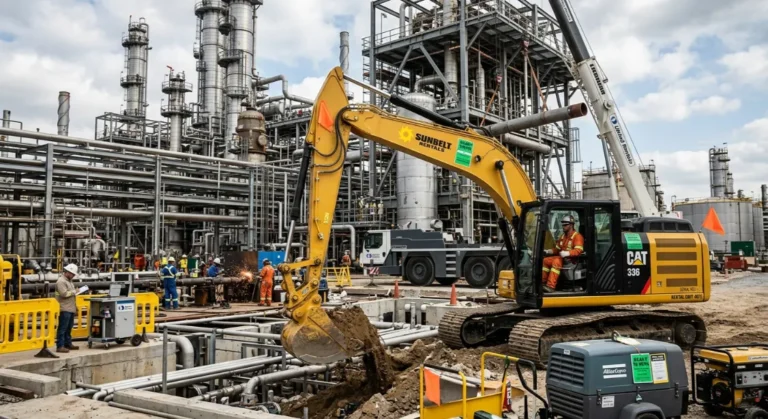
If you have visited a working site in Riyadh lately, you will have noticed the hard hats, the high-visibility vests, the signage, and the permit boards near the gate. None of that is decoration.
The Kingdom has tightened how it watches construction work, and the reason is simple. With the rapid growth of Saudi Arabia’s construction sector under Vision 2030, every construction company must implement safety systems aligned with Saudi labor law and international HSE standards.
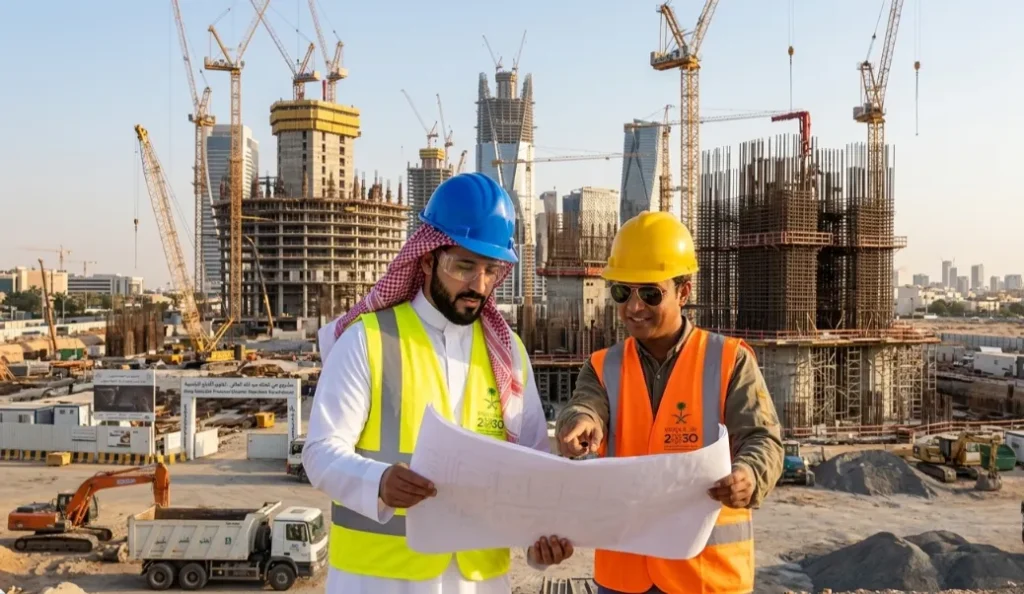
For a project owner, weak safety on-site is not just an ethical problem. It is a commercial risk. A stop-work order can freeze a programme for days, and a serious incident can trigger investigations, fines, and reputational damage.
So when you choose who builds for you, how they handle health, safety, and environment (HSE) tells you a great deal about how they will handle everything else. This guide walks through what the standards are, who enforces them, and what good practice looks like on a real Saudi site. We have written it from the contractor’s side, because knowing the rules and running them day to day are two different things.
Who sets and enforces construction safety in Saudi Arabia
Several bodies share responsibility, and it helps to know who does what.
Ministry of Human Resources and Social Development (MHRSD). This is the main labour regulator. Companies are required to have an occupational safety policy, and the ministry inspects companies that employ more than 49 people to check compliance with the National Strategic Program for Occupational Safety and Health.
The national OSH framework. Saudi Arabia has been building a formal occupational safety and health strategy for 2024 to 2030, in line with international labour conventions. It focuses enforcement on sectors including construction, industry, electricity, energy, gas, oil, water, mining, and quarries. Construction sits near the top of that list for a reason.
Civil Defense. This body governs fire and life safety, including approvals for fire systems on buildings. Its endorsement is part of the permit chain for many projects.
The Saudi Building Code Center. This independent body owns the technical building standards, including the structural, electrical, mechanical, and fire codes that a site must build to.
GOSI. The General Organization for Social Insurance handles work-injury cover and publishes basic occupational safety standards that feed into day-to-day site rules, from forklift operation to PPE.
The takeaway is that a compliant contractor is not answering to one regulator. They keep several different requirements satisfied at once, which is exactly why experience matters.
The core standards your contractor should be following
The Saudi Building Code (2024 edition)
This is the big one. On 30 June 2025, the new 2024 edition of the Saudi Building Code became mandatory. The most relevant volumes for safety are SBC 201, the general building code, and SBC 801, the fire protection code.
These 2024 editions came into effect on 1 July 2025, marking the first major revision since 2018, and align with the 2021 International Fire Code.
There is one nuance if your project started earlier. If a project received approvals such as building permits or Civil Defense endorsement based on the 2018 code before that date, it can proceed under the older edition even if construction continues past 30 June 2025. A good contractor will tell you which edition your project falls under.
The updated fire code also reflects the scale of what the Kingdom is building. SBC 801 adds clearer guidance on fire lanes, turning radii, building access points, and onsite water supply, which is particularly relevant in large developments or remote areas such as the giga-projects.
ISO 45001
Beyond the legal minimum, most serious contractors run their internal safety system to ISO 45001, the international standard for occupational health and safety management. It focuses on hazard prevention, risk control, and continuous improvement of safety systems.
When you see a contractor reference ISO 45001, it signals they treat safety as a managed process, not a reaction to the last near miss.
Permit-to-work and risk assessments
This is where standards meet the dust and noise of an actual site. Before starting any work, companies must prepare risk assessments and method statements that identify hazards, define control measures, and guide safe work execution.
A permit-to-work system then controls the most dangerous tasks, such as hot works, confined-space entry, and electrical work, so nobody starts them without sign-off.
What good HSE actually looks like on a Saudi site
Standards on paper are one thing. Here is what they translate to when you walk a well-run site.
Scaffolding is inspected by trained hands.
Scaffolding must be erected and inspected by trained personnel, with tags showing the last inspection date. An untagged scaffold is a red flag.
PPE is enforced, not suggested.
Hard hats, vests, safety boots, gloves, and eye protection are checked at the gate, and supervisors send people home without them.
Work at height is planned around fall protection.
Working at height is one of the most dangerous construction activities, and fall protection is essential.
Heavy equipment has competent operators.
Operators hold valid Saudi licences, machines are checked before each shift, and exclusion zones keep people clear of moving plant.
Toolbox talks happen daily.
A short morning briefing covers the day’s hazards. It is one of the clearest signs a contractor lives its safety culture.
HSE officers are on site, not in the head office.
A real safety officer walks the site, stops unsafe work, and logs incidents.
The pattern across all of these is supervision. The rules only protect people when someone with authority enforces them every shift, in the heat, under programme pressure.
That is the part that a procurement team cannot see in a tender document. It is also the part that separates a safe contractor from a cheap one. Before you award anything, it is worth reviewing the completed Saudi projects a contractor has actually delivered, because a real record shows whether that discipline holds up.
What happens when safety standards are ignored
The enforcement side has real teeth, and it has been sharpened recently. Saudi labour inspection distinguishes between major and minor violations, with minor breaches given a three-working-day grace period to fix after an electronic warning, while major violations that threaten worker safety are documented immediately and can trigger penalties without prior notice.
The financial penalties are specific. Employers who neglect approved occupational safety and health standards face a fine between SR1,500 and SR5,000, and the firm’s owner or representative is held accountable for any accidents on the premises.
Beyond the fines, companies may face site shutdowns, project delays, and legal action. The lesson for an owner is clear. A contractor who cuts safety corners to quote a lower price exposes your project to delays and your name to risk.
How FSAK approaches safety on every project
Safety is built into how we plan and run work, not bolted on at the end. As a Riyadh-based construction and infrastructure contractor with more than twenty years in the Saudi market, our teams build to the current Saudi Building Code and run method statements before any high-risk activity begins.
Trained supervision stays on site throughout. Because we self-perform much of our work with our own crews and equipment, the safety chain stays short and under direct control, rather than being passed through layers of subcontractors.
You can learn more about FSAK Contracting and the standards we hold ourselves to. The honest summary is simple: a strong safety record is not a marketing line for us. It is what keeps a project on programme, without the stoppages that quietly wreck budgets.
Frequently asked questions
What are the main construction safety standards in Saudi Arabia?
The main standards come from the Saudi Building Code (2024 edition, mandatory since July 2025), the MHRSD occupational safety and health requirements, Civil Defense fire and life safety rules, and GOSI’s basic occupational safety standards. Many contractors also run their internal systems to ISO 45001.
Is there an OSHA equivalent in Saudi Arabia?
There is no single body called OSHA in the Kingdom. The closest equivalent is the occupational safety and health framework enforced by the MHRSD, supported by the national OSH strategy and Civil Defense. It plays a similar role in setting and enforcing workplace safety.
Who inspects construction sites for safety in Saudi Arabia?
The MHRSD runs labour inspections, focusing on larger workforces and higher-risk sectors, including construction. Inspections use a digital risk-scoring system, and inspectors must show official credentials and file a formal report after each visit.
What are the penalties for breaking site safety rules?
Neglecting approved occupational safety and health standards carries a fine between SR1,500 and SR5,000, and the firm’s owner or representative is held responsible for accidents on site. Serious or repeated breaches can also bring site shutdowns, project delays, and legal action.
What should I check before hiring a contractor in Riyadh?
Confirm they build to the current Saudi Building Code, ask whether they run method statements and risk assessments for high-risk work, check that they keep qualified HSE supervision on site, and look at their record on completed projects.