Three machines can get materials or workers to height on a construction site: boom lifts, scissor lifts, and telehandlers. They look different, cost different amounts to rent, and solve different problems. Choosing the wrong one wastes money and slows the schedule. Choosing the right one means the work gets done faster and safer.
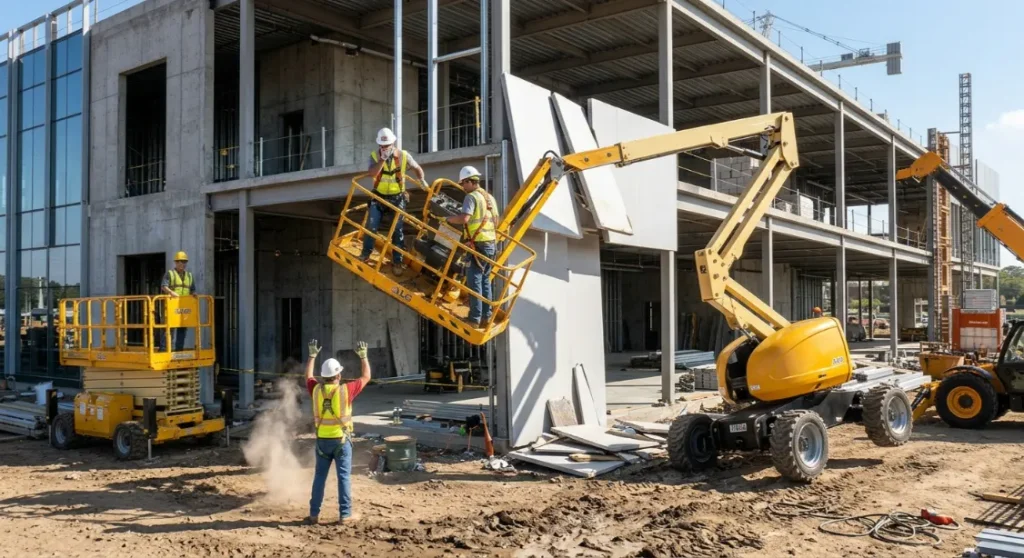
This guide breaks down what each machine actually does, where it works best, and how to decide which one your project needs.
What Each Machine Is Built to Do
Before comparing specs, it helps to understand the core purpose of each machine. They overlap in some areas, but each one excels at a specific job.
Scissor lifts raise a wide platform straight up and down. The platform is large enough for two or three workers plus tools, making them ideal for tasks that cover a broad horizontal area at a consistent height, ceiling installations, ductwork, painting, or electrical fit out. They do not reach outward. Movement is purely vertical.
Boom lifts extend a hydraulic arm upward and outward, positioning a small basket usually one or two workers at precise angles. Articulating boom lifts have jointed arms that can reach up, over, and around obstacles. Telescopic boom lifts have a straight arm that extends further but with less flexibility around obstructions. Boom lifts are the choice when you need to access a specific point that is high up and not directly below the machine.
Telehandlers are material handlers first. A telescopic arm lifts and places heavy loads pallets, steel beams, concrete blocks, pipe bundles, At height and at distance. With a work platform attachment, a telehandler can double as a personnel lift in some situations, but its primary value is load carrying. Typical lift capacities range from around 2,500 kg to over 5,000 kg, far beyond what any boom lift or scissor lift can handle.
Side-by-Side Comparison
| Feature | Scissor Lift | Boom Lift | Telehandler |
|---|---|---|---|
| Primary purpose | Lift workers vertically | Lift workers to hard-to-reach positions | Lift and move heavy materials |
| Typical working height | 6 m, 18 m | 12 m, 56 m+ | 6 m, 20 m |
| Horizontal outreach | None (vertical only) | 6 m, 25 m+ | 3 m, 18 m |
| Platform capacity | 200, 700 kg (workers + tools) | 200, 450 kg (workers) | 2,500, 5,000+ kg (materials) |
| Best terrain | Flat indoor or prepared outdoor surfaces | Varied depends on model | Rough, uneven outdoor ground |
| Attachment versatility | Low (fixed platform) | Low (basket only) | High (forks, buckets, winches, work platforms) |
| Indoor suitability | Excellent (electric models) | Good (compact electric models) | Limited (large footprint, exhaust) |
| Relative rental cost | Lowest | Moderate to high | Moderate |
When a Scissor Lift Is the Right Call
A scissor lift earns its place on any project where the work covers a wide area at a consistent height. A ceiling, spraying or rolling paint across a wall, installing suspended ceilings, or running cable trays these are jobs where the large platform and vertical only movement are advantages, not limitations.
Electric scissor lifts produce zero emissions and low noise, which makes them the standard choice for enclosed or partially enclosed spaces like shopping centres, warehouses, car parks, and airport terminals. Rough terrain diesel scissor lifts exist for outdoor use, but their working height rarely exceeds 18 m, which limits them to low and mid rise work.
Choose a scissor lift when:
- Workers need a stable, spacious platform at moderate height
- The task involves covering a wide area horizontally (not reaching one specific point)
- The site surface is flat or prepared
- Indoor air quality and noise restrictions apply
When a Boom Lift Makes More Sense
Boom lifts solve the access problems that scissor lifts cannot. If the work point is high up, offset to one side, or blocked by structural obstacles, a boom lift’s articulated or telescopic arm can reach it.
Exterior cladding installation, structural steel connections, facade cleaning, billboard mounting, high voltage cable routing along bridge structures, and industrial plant maintenance all rely on boom lifts. The operator positions the basket precisely up, over, and around using the boom’s articulated joints.
Articulating boom lifts handle congested environments. A warehouse with racking, a plant with pipework, or a building with overhanging balconies these situations require the boom to bend around obstacles. Telescopic straight boom lifts trade that flexibility for greater maximum height and reach, making them better for open air work at extreme heights.
Choose a boom lift when:
- The work point is high and not directly accessible from below
- Workers need to reach around, over, or past obstacles
- The task is position specific (one spot, not a broad area)
- Working height exceeds 18 m
When a Telehandler Is the Better Option
If the job is about moving materials rather than positioning workers, the telehandler is the machine. A boom lift basket cannot hold a pallet of concrete blocks. A scissor lift cannot deliver steel beams to the third floor of a structure under construction. A telehandler does both, and it does them on rough ground.
Construction sites in early stages earthworks, structural frame erection, masonry frequently need materials placed at height and at a distance from the machine. Telehandlers handle this with a telescopic boom and forks, reaching forward and upward simultaneously. Swap the forks for a bucket, and the telehandler moves aggregate or soil. Swap for a work platform, and it becomes a basic personnel lift.
This attachment flexibility is the telehandler’s real advantage over the other two machines. On a busy site where equipment budgets are tight, one telehandler with three or four attachments can cover tasks that would otherwise require two or three separate machines.
Choose a telehandler when:
- The primary task is lifting and placing heavy materials at height
- The site surface is rough, unprepared, or uneven
- You need one machine that can handle multiple roles (forks, bucket, work platform)
- Load weight exceeds what a boom lift or scissor lift platform can support
Can One Machine Replace the Others?
A telehandler with a work-platform attachment can lift workers, but the ride quality is rougher than a purpose built boom lift, and platform capacity is typically lower. Regulations in many markets require specific certifications for personnel lifting with telehandlers, adding compliance complexity.
A boom lift can carry some materials in the basket, but the weight limit (usually under 450 kg including the operator) rules out anything heavy. Trying to lift materials beyond the basket’s rated capacity is a safety violation.
A scissor lift cannot replace either of the other two when outreach is needed. It only goes straight up.
The most efficient approach on large or multi phase projects is to use each machine where it fits best. A telehandler handles material logistics, a boom lift positions workers at height for precision tasks, and a scissor lift covers wide area fit out work at lower heights.
What About Cost?
Rental rates vary by machine size, rental period, and market conditions. As a general rule:
- Scissor lifts are the most affordable to rent, particularly electric models for indoor work.
- Telehandlers sit in the mid range, with rates increasing for higher capacity models.
- Boom lifts tend to carry the highest daily rates, especially articulating models with 20 m+ reach.
The cheaper machine is not always the cheaper choice. Renting a scissor lift when you actually need a boom lift means workers cannot reach the work point, and the project stalls. Renting a boom lift when a scissor lift would suffice means paying more for capability you do not use. Matching the machine to the task is the real cost-saving decision.
If you are managing a project that involves multiple task types material placement, high level access, and wide area fit out renting a combination of machines often costs less in total project time than trying to force one machine into roles it was not designed for.
Safety Considerations Across All Three
Every aerial work platform requires trained, certified operators. The specific training requirements differ by machine type:
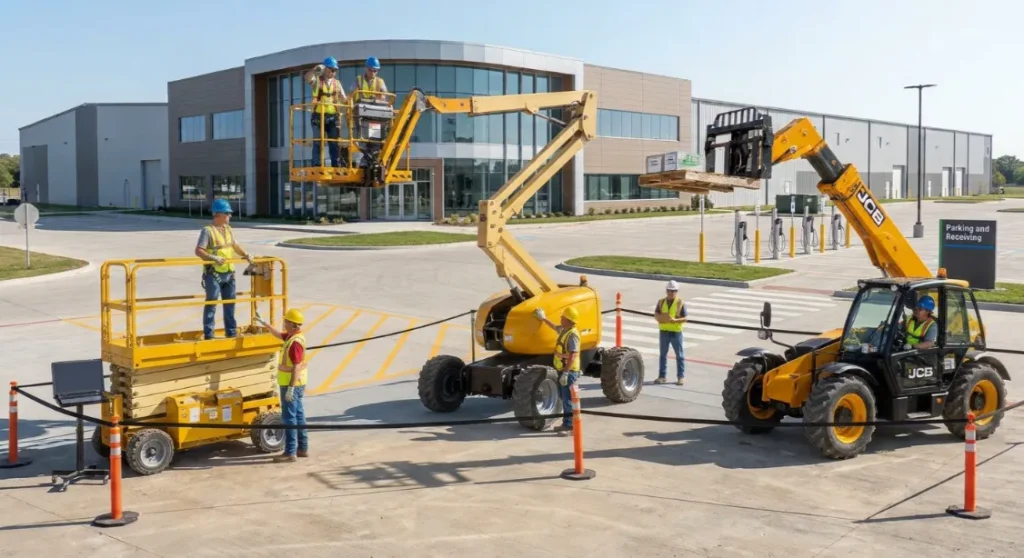
- Scissor lift operators need training on fall protection, platform load limits, wind speed thresholds, and ground surface assessment.
- Boom lift operators need additional training on boom stability, swing radius awareness, overhead clearances, and emergency lowering procedures.
- Telehandler operators need load chart training, attachment changeover procedures, and ground condition assessment to prevent tipping.
Pre use inspections are mandatory for all three. Check hydraulic lines, control functions, safety rails or harness anchor points, tyres or tracks, and emergency stop systems before every shift.
Rent the Right Machine for Your Project
FSAK Contracting provides boom lift and scissor lift rental alongside telehandler and heavy equipment hire, well maintained fleet. Whether you need a single machine for a short term fit out or a fleet package for a multi phase construction project, our team helps you match the right equipment to the job.
Need help choosing? Contact the FSAK equipment team for a same day quote, or explore our full equipment rental range.
Frequently Asked Questions
What is the main difference between a boom lift and a scissor lift?
A scissor lift raises a wide platform straight up for work at consistent heights. A boom lift extends an arm upward and outward, positioning a smaller basket at angles and around obstacles. Scissor lifts cover broad areas; boom lifts reach specific points.
Can a telehandler be used as a boom lift?
With a work platform attachment, a telehandler can lift workers to moderate heights. However, it offers less positioning precision than a boom lift, and regulations in many markets require specific certification and compliance checks before using a telehandler for personnel lifting.
How high can each machine reach?
Scissor lifts typically reach up to 18 m working height. Telehandlers reach between 6 m and 20 m depending on the model. Boom lifts offer the greatest range, from around 12 m to over 56 m for large telescopic models.
Which lift is best for indoor construction work?
Electric scissor lifts are the standard for indoor work. They produce zero emissions, operate quietly, and provide a spacious platform for tasks like ceiling installation, painting, and electrical fit out. Compact electric boom lifts can also work indoors when outreach is needed in tight spaces.