Most bridges in Saudi Arabia are built with one of six methods: precast girders, cast in situ concrete, balanced cantilever, incremental launching, or steel and composite decks. The right choice depends on span length, site access, traffic below the bridge, and the time you have.
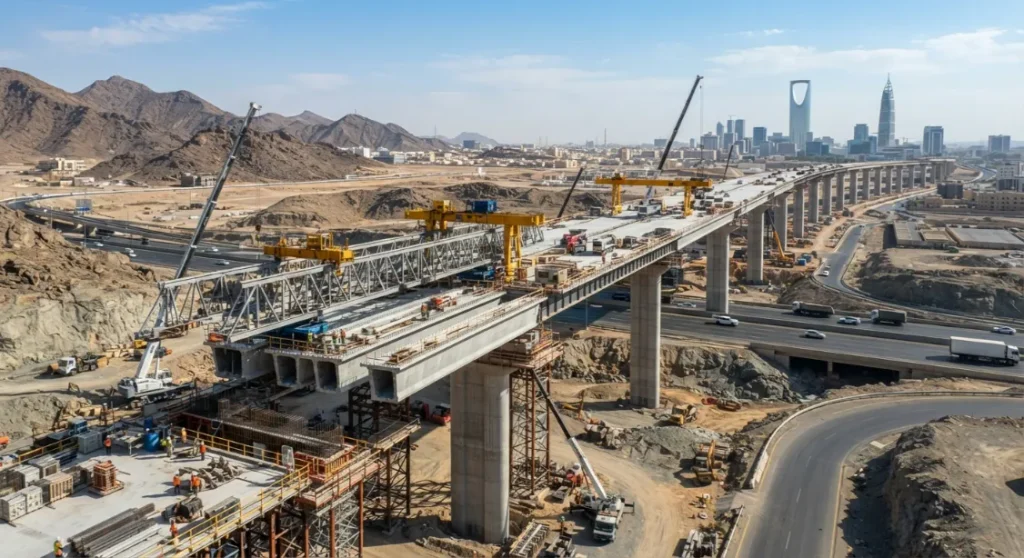
This guide explains each of the main bridge construction methods in Saudi Arabia in plain language. We also cover what changes when you build in 50°C summers, on salty ground, or next to a busy highway that cannot close.
If you are a project manager, developer or engineer planning an overpass, interchange, this should help you ask the right questions before design is fixed.
Quick Comparison of Bridge Construction Methods
| Method | Typical span range | Best suited for | Main advantage | Main watch-out |
|---|---|---|---|---|
| Precast girders | About 20 to 40 m | Overpasses, interchanges, repeated spans | Fast on site, less work over traffic | Needs heavy cranes and good access for lifting |
| Cast-in-situ concrete | Short to medium spans, any shape | Curved ramps, wide or skewed decks | Fits complex geometry | Falsework blocks the ground below for weeks |
| Balanced cantilever | Often 60 m and above | Wadis, deep valleys, long river crossings | No falsework needed under the span | Slow cycle per segment, needs skilled crews |
| Incremental launching | About 30 to 60 m per span | Straight or constant-curve viaducts | All casting happens in one yard behind the abutment | Alignment must suit launching |
| Span-by-span with gantry | About 30 to 50 m | Long elevated roads and transit viaducts | Very fast once the gantry is running | High setup cost, only pays off on long lengths |
| Steel and composite | Short to long spans | Fast crossings, lightweight decks, pedestrian bridges | Light, quick to erect | Corrosion protection and higher heat movement |
6 Common Bridge Construction Methods in Saudi Arabia
Precast Girder Bridges
This is the method you see on most highway overpasses. Prestressed concrete girders are cast in a factory or a site casting yard, cured under control, then trucked to site and lifted onto the piers. A concrete deck slab is then cast on top.
Why it is popular here: the girders are made in shade and controlled conditions, away from the worst of the heat. Work over live traffic is limited to the lifting nights. For a project with 15 or 20 similar spans, the moulds pay for themselves fast.
The catch is lifting. A long girder can weigh well over 100 tonnes, so you need large mobile or crawler cranes, firm crane pads and a clear lifting plan. Our guide on mobile crane vs crawler crane explains how teams pick between the two.
Cast in Situ Concrete Bridges
Here the deck is formed and poured in its final position. Crews build falsework temporary support towers from the ground, fix the formwork and steel, and pour the deck in place. Post tensioning is often added once the concrete gains strength.
The downside is time on the ground. Falsework blocks the area under the bridge for weeks, and every pour needs a hot weather concreting plan in summer.
Balanced Cantilever Construction
Balanced cantilever is used when the bridge has to cross something you cannot put support towers in, such as a deep wadi or a wide channel. The deck is built outwards from each pier in short segments, one on each side, so the pier stays balanced. Form travellers move forward after every segment until the two arms meet in the middle.
Incremental Launching
The whole deck is cast in short sections in a fixed yard behind one abutment. Each new section is joined to the previous one and the deck is pushed forward with hydraulic jacks, sliding over the piers on temporary bearings.
This keeps all casting work in one place, which is useful for crossings over railways, roads or protected ground. It only works when the alignment is straight or follows a constant curve.
Span by Span Erection with a Launching Gantry
For long elevated roads and transit viaducts, a launching gantry sits on top of the piers. Precast segments for a full span are hung from it, joined and stressed, then the gantry moves to the next span. Crews can often complete a span every few days once the system is running.
Steel and Composite Bridges
Steel girders with a concrete deck composite are light and quick to erect. They are used for pedestrian bridges, some interchange ramps, and places where foundations must carry less weight.
In Saudi Arabia the two big topics with steel are corrosion protection near the coast and larger thermal movement, which we cover below.
Precast vs Cast in Situ Bridges: Which Suits Saudi Conditions?
This is the most common decision on overpass and flyover projects, so here is a direct comparison.
| Factor | Precast | Cast-in-situ |
|---|---|---|
| Speed on site | Faster, girders arrive ready | Slower, each pour needs forming and curing |
| Quality control | Factory or yard control, steady curing | Depends on site conditions and supervision |
| Summer heat | Less exposed, curing is easier to manage | Every pour needs a heat plan |
| Traffic disruption | Short closures for lifting, often at night | Longer closures while falsework stands |
| Geometry | Best for straight or gently curved repeated spans | Handles curves, skews and changing widths |
| Equipment | Heavy cranes and transport | Falsework, formwork, concrete pumps |
| Joints | More deck joints unless made continuous | Fewer joints, continuous deck |
In short, precast usually wins on busy urban flyovers with repeated spans. Cast in situ wins on curved ramps and one off structures. Many interchanges use both: precast for the main spans and cast in situ for the curved connecting ramps.
Bridge Design Standards in KSA: What Usually Applies
Every bridge project in the Kingdom has its own contract specification. In most cases it points to the national building code, national highway specifications, and recognised international bridge design codes for loads and detailing. The project spec is what the contractor is held to, so read it before you price or plan methods.
The items that most often affect how a bridge is built are:
- Design loads for traffic, including heavy trucks and abnormal loads on industrial routes
- Minimum concrete cover and concrete grade for durability in aggressive soil or coastal air
- Bearing and expansion joint types, and how much movement they must allow
- Load testing, material testing and inspection hold points
- Rules for hot-weather concreting and curing
All technical requirements must be confirmed with the project’s design engineer and the approved specification. This article is general guidance, not engineering advice.
Designing and Building Bridges for Saudi Heat
Heat affects a bridge twice: while you build it, and every day after it opens.
Movement in service. Concrete and steel grow when they heat up. A rough example: a 100 m concrete deck with a 40°C swing between a winter night and a summer afternoon moves around 45 to 50 mm. That movement has to go somewhere, which is why expansion joints and bearings are sized for the local temperature range. Steel decks and dark asphalt surfaces get hotter than the air, so designers also check the temperature difference between the top and bottom of the deck.
Concrete placing in summer. Many project specs set a maximum concrete temperature at placing, often around 32 to 35°C. To stay under it, crews commonly:
- Pour at night or early morning
- Use chilled water or ice in the mix
- Shade aggregate stockpiles and keep pump lines covered
- Start curing right away with wet hessian, water spraying or curing compound
- Keep curing going for the full period in the spec, not just the first day
Skipping these steps leads to plastic shrinkage cracks, which let salt and moisture into the deck later.
Soil, Groundwater and Salt: Building Strong Bridge Foundations
Bridge foundations carry the whole load, so ground conditions decide a lot of the method and cost.
Coastal areas around Jeddah, Dammam and Jubail often have sabkha salt flat soils with high groundwater and high sulfate and chloride levels. These attack concrete and steel. Common answers include bored piles taken down to a stronger layer, sulfate resisting cement, extra concrete cover, protective coatings on buried concrete, and sometimes coated or stainless rebar in splash zones. You can read more in our article on sabkha soil treatment.
Where groundwater is high, pile caps and pier footings need a dry excavation. Our guide to dewatering methods covers the options. Good site preparation before any of this starts is part of earth and enabling works.
Inland cities like Riyadh usually have firmer ground, but some areas have limestone with cavities. A proper soil investigation with boreholes at every pier location saves a lot of trouble later.
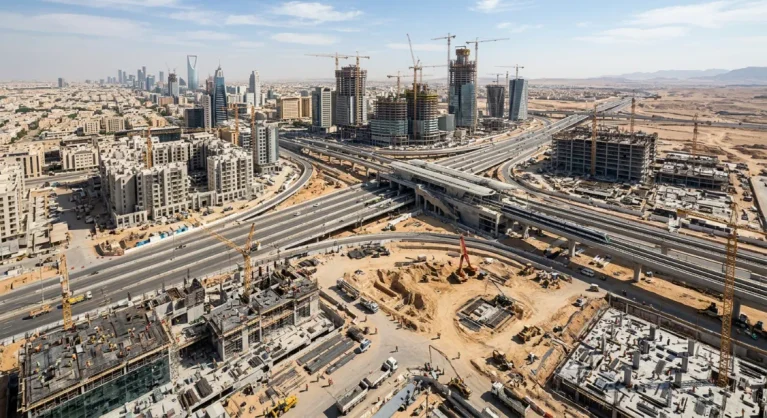
Flyover Construction in Riyadh and Other Busy Cities
Building a flyover in the middle of a working city is as much about traffic and services as it is about concrete.
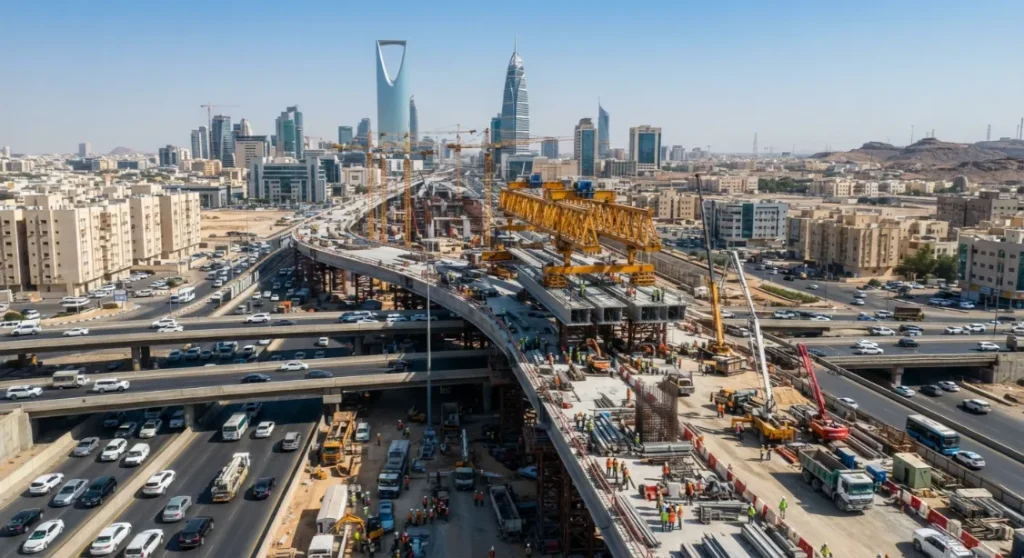
A few things that make flyover construction in Saudi Arabia go smoothly:
- Plan diversions early. Each stage of work needs a safe, approved traffic layout before crews mobilise.
- Find the services first. Water, power and telecom lines often run under the pier positions. Locating and moving them is usually the first real work on site, which is where utility installation teams come in.
- Choose methods that cut closures. Precast girders or a launching gantry reduce the time the road below is blocked. Heavy lifts are normally done at night.
- Keep the approach roads in mind. The bridge is only useful once the ramps, paving and drainage around it are done. Our road construction best practices post covers that side of the job.
Best Practices Checklist for Bridge Projects
Use this as a quick check before work starts:
- Soil investigation complete at every pier and abutment
- Construction method agreed between designer and contractor before detailed design is frozen
- Lifting plan, crane pads and ground bearing checks for every heavy lift
- Hot-weather concreting and curing plan approved
- Durability measures set for the soil and exposure (cover, cement type, coatings)
- Bearings and expansion joints ordered early, as they often have long lead times
- Survey control plan, especially for cantilever and launched decks
- Traffic management and utility diversion plans approved for each stage
- Inspection and testing hold points agreed with the client
How FSAK Supports Bridge and Infrastructure Projects
FSAK Contracting provides road, bridge and tunnel works from our base in Riyadh, along with the earthworks, utilities and equipment that bridge jobs depend on. If you are looking for an infrastructure contractor in Saudi Arabia that can support a bridge package or the works around it, you can see examples of our work on our projects page.
Frequently Asked Questions
What is the most common bridge construction method in Saudi Arabia?
Precast prestressed concrete girders are widely used for highway overpasses and interchanges because they are fast to install and limit work over traffic. Cast-in-situ concrete is common for curved ramps and complex shapes.
How long does it take to build a flyover?
It depends on length, method, foundations and how much utility diversion is needed. A simple single overpass may take several months, while a large multi-level interchange can take well over a year.
What foundations are used for bridges on sabkha or salty soil?
Bored piles taken down to a stronger layer are common, along with sulfate-resisting cement, extra concrete cover and protective coatings. The exact solution depends on the soil investigation results.
What should I check before hiring a bridge contractor?
Ask for similar completed bridge work, the equipment they can bring to site, their safety and quality procedures, and how they plan to handle traffic and utilities. Check that their team understands the method chosen for your bridge.