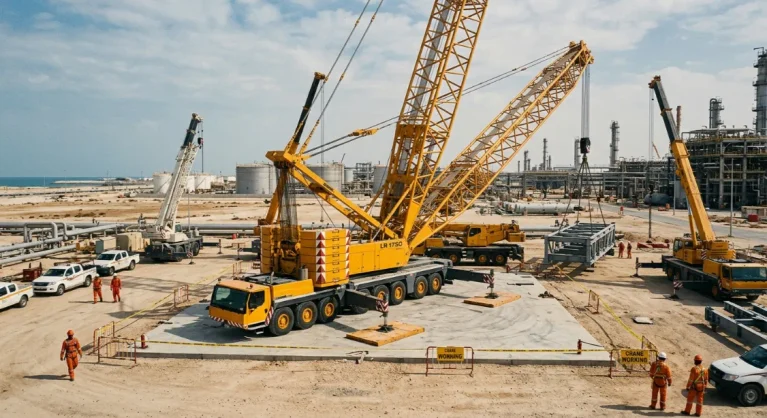
An oversized excavator wastes fuel, damages finished surfaces and sits idle when it cannot fit through the site gate. An undersized one struggles against hard material, repositions constantly and turns a two day job into a week. Neither saves money.
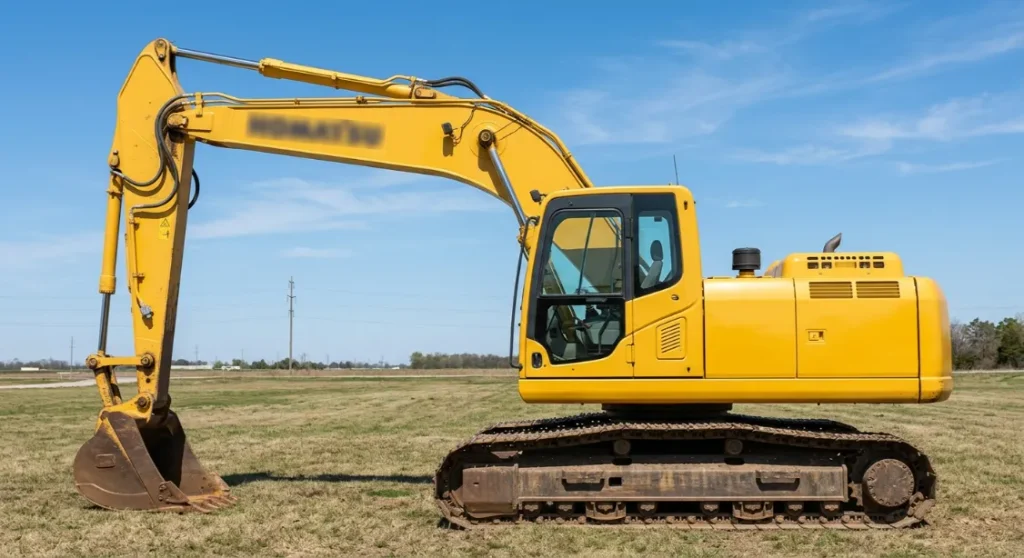
This guide explains excavator weight classes in plain terms, covers the specifications that actually determine whether a machine suits a task, and offers a practical decision framework you can use before you hire an excavator or sign a purchase order.
Why Size Matters More Than Brand
Operating weight is the single most useful number when comparing excavators. It correlates directly with dig depth, breakout force, bucket capacity and the range of attachments the hydraulic system can power. Two machines of the same weight class from different manufacturers will perform more similarly to each other than a mini and a standard crawler from the same brand.
Weight also decides transport logistics. A mini excavator rides on a standard flatbed trailer towed by a pickup truck. A 30 tonne crawler needs a dedicated lowbed and heavy haulage permits. These transport costs are real and recurring, especially on shorter hires.
Focus on weight class first. Brand, model and year matter but they come second.
Four Weight Classes, Explained
The industry groups excavators into four bands based on operating weight the mass of the machine with a full fuel tank, hydraulic oil and a standard bucket fitted.
Mini Excavators, Under 6 Tonnes
Mini excavators are the lightest tracked machines in the range. Most models sit between 1.5 and 5.5 tonnes, with dig depths from roughly 2 to 4 metres and bucket widths from 300 mm to 600 mm.
Their defining advantage is access. A machine under 1.5 metres wide can pass through compound gates, work inside partially completed structures and operate alongside finished landscaping without tearing it up. Many minis feature zero or near-zero tail swing, meaning the upper carriage does not overhang the tracks during rotation.
Suited for: service trenches, landscape grading, utility laterals, drainage runs, work in walled compounds, indoor and basement excavation.
Limitations: low breakout force, small bucket volume, slow cycle times in dense material. A mini excavator is not a production earthmoving machine.
Midi Excavators, 6 to 12 Tonnes
The midi class is the step up contractors reach for when a mini cannot produce enough material per cycle. Operating weights typically fall between 6 and 12 tonnes, with dig depths of 3.5 to 5 metres and bucket widths up to about 900 mm.
Midi machines still fit on medium duty trailers and do not always need heavy haulage escort. They handle mixed ground conditions, loose fill, compacted sand, light rock, better than minis because they carry more hydraulic pressure and greater machine weight to anchor against.
Suited for: small foundations, footpath and kerb works, drainage installation, light commercial site preparation, backfilling and compaction support.
Limitations: not enough breakout force for sustained hard rock work. Transport weight starts to matter, a 12 tonne machine on a trailer is around 18 tonnes gross, beyond the towing capacity of most light commercial vehicles.
Standard Crawlers, 13 to 30 Tonnes
This is the workhorse class. Standard crawlers are the default choice on most civil and building sites where the job involves moving significant volumes of soil, loading trucks for disposal, or excavating foundations deeper than 4 metres. Dig depths range from 5 to 7 metres, and bucket capacities from 0.5 m³ to over 1.5 m³.
At this weight, the hydraulic system can run a wide variety of attachments, breakers, grapples, rippers and compaction plates, without starving flow. A quick coupler lets the operator swap between attachments in minutes instead of waiting for a second machine.
Suited for: bulk excavation and truck loading, foundation digs, road box formation, canal and channel work, demolition with hydraulic breaker, material sorting with grapple.
Limitations: requires a lowbed for transport, higher daily fuel consumption, significant ground bearing pressure on soft soils, and a larger turning footprint that rules out tight urban spaces.
Large Crawlers, Above 30 Tonnes
Large excavators are specialist machines for deep bulk digs, quarry loading, heavy demolition and rock breaking. Operating weights commonly range from 30 to 80 tonnes, with some mining class machines exceeding 100 tonnes. Bucket capacities start at about 1.5 m³ and climb from there.
The economics of a large excavator only work on high volume, long duration projects where the machine runs full shifts and the daily output justifies the transport, fuel and operator cost. They are not general purpose machines.
Suited for: deep basement excavation, quarry and borrow-pit loading, large-scale earthworks on open sites, heavy rock breaking, mass grading.
Limitations: high mobilisation cost, specialist lowbed transport required, limited site access, ground damage on weak soils, and high daily operating cost even when partially utilised.
How Dig Depth, Reach and Bucket Capacity Relate to Weight
Operating weight is the starting point, but three secondary specifications determine whether a specific machine actually fits the task.
| Specification | What it controls | Why it matters |
|---|---|---|
| Dig depth | Maximum vertical distance the bucket can reach below track level | Determines whether the machine can hit the bottom of a foundation, trench or utility run without benching |
| Reach | Maximum horizontal distance from the centre of rotation to the bucket teeth | Determines how far the machine can dig or dump without repositioning, critical on confined sites or when loading trucks positioned to the side |
| Bucket capacity | Volume of material the bucket holds per cycle, measured in cubic metres | Directly affects production rate, the number of truck loads you can fill per hour |
Two machines in the same weight class can have different dig depths depending on boom and arm length. A long-arm option on a 20-tonne crawler will reach deeper than the standard arm, but it trades lifting capacity. Always confirm the specific model’s spec sheet against the depth your project needs, do not assume all machines within a weight band perform identically.
Choosing the Right Size for Common Construction Tasks
Rather than starting with a machine and looking for a job, start with the job and work backwards to the machine.
| Residential service trench (water, electrical, telecom) | 1,2 m | Mini (under 6 t) | Narrow trench, tight access, minimal reinstatement |
| Stormwater drainage run | 2,3 m | Midi (6,12 t) | Deeper cut, larger pipe, needs higher bucket capacity |
| Building foundation | 3,5 m | Standard crawler (13,30 t) | Volume of excavated material justifies larger bucket |
| Road box excavation | 0.5,1 m depth, long linear runs | Standard crawler (20,25 t) | Linear production efficiency and truck loading speed |
| Deep basement dig | 6 m + | Large crawler (30 t +) | Depth, volume, and material density demand breakout force |
| Landscape grading and pond shaping | 1,2 m | Mini to midi (3,10 t) | Precision and low ground damage are more important than raw output |
If you are renting equipment for a Saudi construction site, send the task description and site dimensions to the hire company rather than asking for a specific tonnage. A good hire desk will match the class and attachments for you.
What About Long Reach Excavators?
Long reach machines are standard crawlers fitted with an extended boom and arm, giving horizontal reaches of 15 to 25 metres or more. They do not form a separate weight class, the carrier is typically a 20 to 35 tonne crawler.
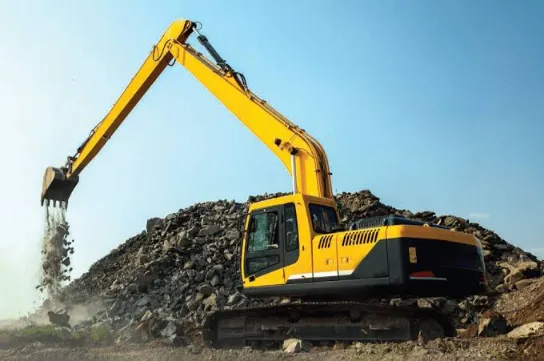
Use cases are specific: canal maintenance from the bank, slope trimming at a distance the operator cannot safely approach, and high face profiling. If the work can be done by a standard arm machine positioned closer, the standard arm is more efficient, it cycles faster and lifts more.
How Terrain and Ground Conditions Affect Your Choice
Sand behaves differently from compacted fill, and compacted fill behaves differently from fractured rock. The ground you are digging determines how hard the machine works per cycle, and therefore how quickly it wears and how much fuel it burns.
Loose sand and soft soil: Lower breakout force needed, but track sinkage increases. A wider track machine or a lighter class reduces the risk of bogging. On very soft ground, timber mats or temporary access roads may be needed regardless of machine weight.
Compacted fill or gravel: Medium breakout force. Standard crawlers handle this well. Midi machines work if the volume is moderate.
Rock and cemented ground: High breakout force required. A hydraulic breaker attachment on a standard or large crawler is the normal approach. Undersizing the carrier here means the breaker cannot deliver full impact energy, slowing work and stressing the machine.
Hot, dry conditions also affect machine choice indirectly. Cooling systems work harder, and dust clogs filters faster. A machine with a well maintained cooling pack and clean air filtration performs better than a newer machine with neglected service. That is one reason why hiring from a contractor that maintains its own fleet gives a different result from hiring from a pure rental yard.
Attachments Change What a Single Machine Can Do
A single excavator carrier paired with the right attachments can replace two or three machines on site. The key is hydraulic compatibility, the carrier must deliver enough flow and pressure to run the attachment at its rated performance.
Common attachment pairings by class:
| Attachment | Minimum carrier class | Typical use |
|---|---|---|
| Trenching bucket (300–450 mm) | Mini (3 t +) | Service trenches, cable runs |
| Grading bucket (1,200–1,800 mm) | Midi (8 t +) | Level trimming, surface finishing |
| Hydraulic breaker | Standard crawler (15 t +) | Rock breaking, old concrete removal |
| Sorting grapple | Standard crawler (18 t +) | Demolition material separation |
| Compaction plate | Midi (8 t +) | Trench backfill compaction |
| Tilt bucket | Midi (6 t +) | Slope grading, ditch shaping |
When booking a hire, confirm the attachment with the machine, not separately. A breaker rated for a 25 tonne carrier will not perform on a 14 tonne machine, and mounting it risks damaging the arm and hydraulic circuit. FSAK’s wider earthworks and enabling works service handles both the machine and the scope, so the attachment match is always right.
Three Sizing Mistakes That Cost Time and Money
1. Choosing the biggest machine available “just in case.” An oversized machine burns more fuel, takes longer to mobilise, may not fit through the gate, and applies ground pressure that damages finished surfaces. Hire the machine that fits the tightest part of the work. If one section genuinely needs a larger class, hire it for that section only.
2. Ignoring site access until the lowbed arrives. Measure gate widths, overhead clearances and turning radii before confirming the machine. A 25-tonne crawler with a 2.9 metre wide undercarriage will not pass through a 2.5 metre compound gate, and discovering that on delivery day wastes everyone’s time and money.
3. Skipping the attachment conversation. If the job involves both bulk digging and trench work, you need two buckets, not two machines. Confirm the attachment requirements when you book. A machine delivered without the correct bucket is a machine standing idle.
An excavator is only one part of most site work. Before the digging starts, the ground often needs to be cleared, pushed, loaded and levelled, and that takes other machines. If your job needs more than digging, see our earthmoving equipment rental page. It covers bulldozers, wheel loaders, backhoe loaders, skid steers and motor graders, and it shows which machine fits which task. Send us your site details and we will help you pick the right mix.
Frequently Asked Questions
What is the difference between operating weight and shipping weight?
Operating weight is the machine fully fuelled, with hydraulic oil and a standard bucket fitted. Shipping weight strips out fuel and often the bucket, so it is lighter. Operating weight is the figure to use when checking transport limits and ground bearing capacity.
Can a mini excavator break rock?
A mini breaker suits removing old concrete footings or thin surface rock. Solid bedrock or thick reinforced slabs need a standard crawler with a larger breaker, trying to force the job with a mini wastes time and risks damaging the machine.
How do I know what dig depth I need?
Start with the project specification. Utility trenches are defined by the pipe invert level plus bedding depth. Foundations are defined by the structural engineer’s drawings. If neither is available yet, a site investigation or trial pit will tell you what is in the ground and how deep you need to go.
Is a wheeled excavator better than a tracked one?
It depends on the surface. Wheeled excavators move faster on roads and hard standing, and they do not damage tarmac. Tracked excavators offer better traction on loose ground, slopes and soft soil. Wheeled excavators are more common in urban roadwork and utility maintenance where the machine moves between locations on paved roads.