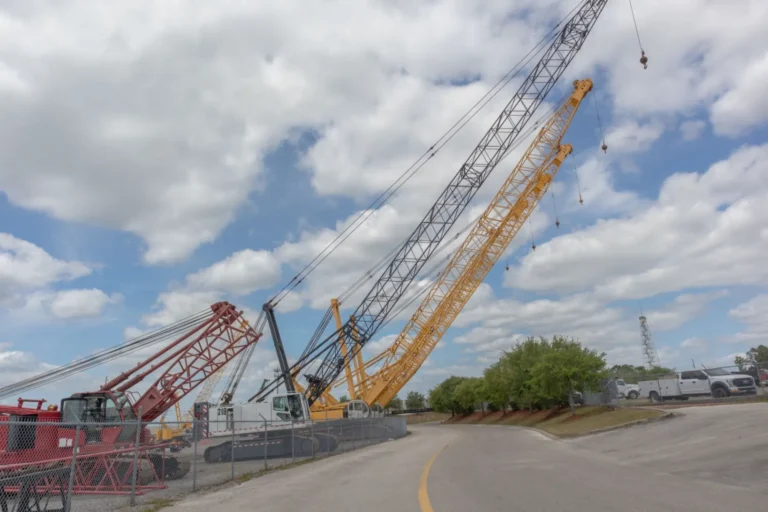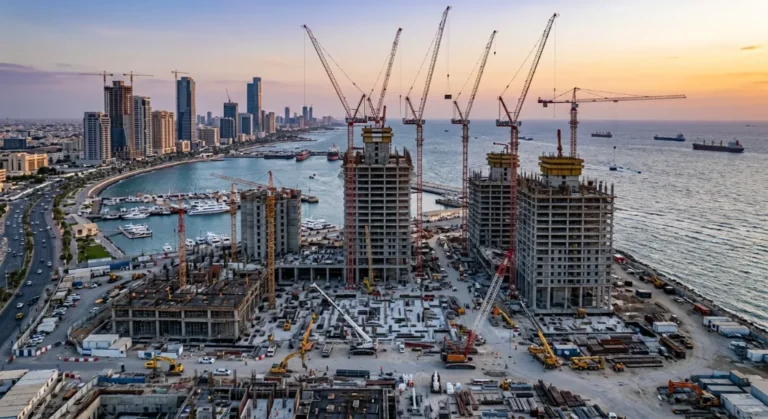
A crane that works fine on a Riyadh building site can still be turned away at a Jubail plant gate. The inspection sticker may be out of date. The load chart may not match the set-up. Or the ground under the outriggers may be soft salt flat that cannot carry the load.
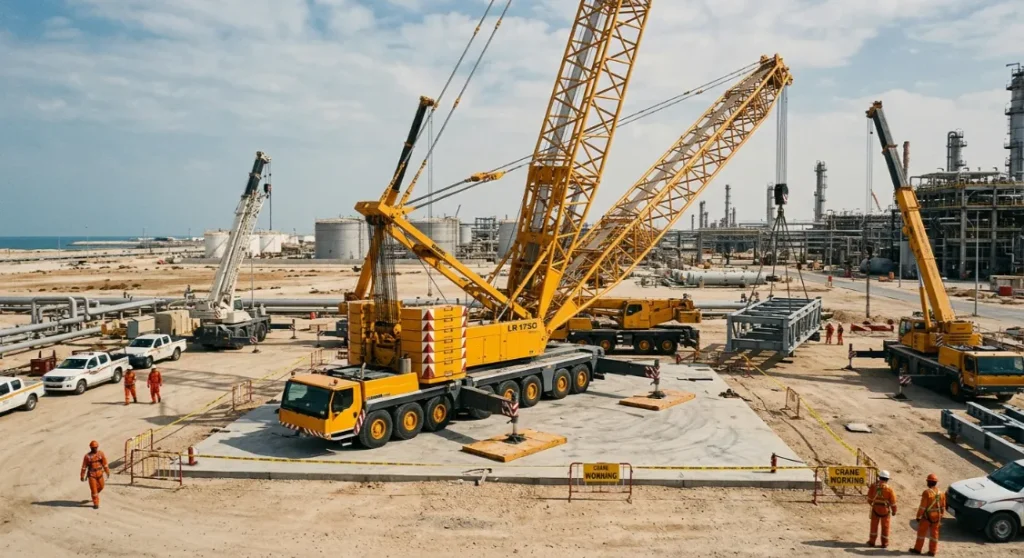
This guide covers the specifications and safety requirements that decide crane rental in Jubail Industrial City. It is written for project engineers, HSE leads and buyers who want to book the right crane the first time.
FSAK Contracting is a construction contractor based in Riyadh with more than 20 years of work in Saudi Arabia. We supply operated mobile cranes from our own fleet to industrial sites across the Eastern Province.
What crane specifications matter most for a Jubail lift?
Five specifications decide a lift: rated capacity at your working radius, boom length, hook height, counterweight and outrigger spread. The tonnage in a crane’s name is its maximum at the shortest radius. At the radius your job needs, the same crane may lift far less.
Rated capacity is a ceiling, not a working figure
A crane sold as 100 tonnes lifts 100 tonnes only close to its centre, with full counterweight and outriggers fully extended. Move the hook further out and capacity drops quickly. So never choose a crane by its class alone.
Radius and boom length
Radius is the flat distance from the crane’s centre of rotation to the centre of the load. Check it at the pick point and at the landing point, and plan on the larger one. Boom length follows from radius and hook height. A longer boom reaches further but carries less.
Hook height and obstructions
Pipe racks, cable trays and live process equipment fill most plant plots. The hook must clear them with room for the slings and the load itself. Add the rigging height to the load height when you work out the hook height you need.
Counterweight and outrigger spread
Every load chart assumes a set counterweight and a set outrigger position. If a tight plot stops the outriggers going fully out, a different and lower chart applies. Tell your supplier about space limits before the crane is chosen, not on the day.
| Specification | What it controls | What to give your crane supplier |
| Rated capacity at radius | The safe load at your real reach | Load weight and landing radius |
| Boom length | Reach and hook height | Pick and set points marked on a site plan |
| Hook height | Clearance over plant and structures | Heights of pipe racks and nearby steel |
| Counterweight | Capacity and tail swing | Free space behind the crane |
| Outrigger spread | Stability and which chart applies | Plot size and ground at each pad |
| Rigging weight | Part of the load the crane must carry | Slings, shackles, spreader bar and hook block |
Which crane type fits which job in Jubail?
Most plant work in Jubail uses wheeled mobile cranes, because they travel by road and set up fast. Crawler cranes suit long, heavy campaigns on prepared ground. Tower cranes suit tall buildings. Boom trucks and pick-and-carry cranes handle light, frequent lifts in yards and laydown areas.
| Crane type | Best suited to | Ground and set-up | Watch for |
| Boom truck (truck-mounted crane) | Light lifts, material delivery, utility work | Sets up quickly on firm paving | Low capacity at long reach |
| Rough terrain crane | Unpaved plots and early site work | Large tyres for loose ground; outriggers still needed | Slow and limited on public roads |
| All-terrain crane | General plant lifts, steel erection, shutdown work | Road legal; lifts on outriggers | Needs firm pads and full outrigger space |
| Crawler crane | Heavy, long campaigns such as vessels and tanks | Tracks spread the load but need a level, prepared surface | Arrives in parts; assembly takes time and space |
| Tower crane | Multi-storey buildings | Fixed base on a designed foundation | Erection and dismantling time |
| Pick-and-carry crane | Moving loads short distances in a yard | Travels with the load on firm, level ground | Strict limits on slope and travel load |
FSAK’s own fleet covers mobile cranes from 25 to 100 tonnes, with tower and pick-and-carry cranes on request.
How do you read a load chart before you hire?
Find the row for your radius and the column for your boom length. The figure where they meet is the gross capacity. Subtract the hook block and all rigging. What is left is the heaviest load you can lift, and only in the exact set-up that chart describes.
- Confirm the chart matches the set-up: counterweight, outrigger spread and boom configuration.
- Find your working radius. If it falls between two rows, use the larger radius.
- Find your boom length. If it falls between two columns, use the longer boom.
- Read the gross capacity where the row and column meet.
- Deduct the hook block, slings, shackles and any spreader beam.
- Check the maximum wind speed printed with that chart.
- Work out your load as a percentage of the capacity left.
Here is a worked example with round numbers, for illustration only. A pump skid weighs 18 tonnes. The rigging and hook block add 1.2 tonnes, so the crane carries 19.2 tonnes. The chart allows 24 tonnes at the landing radius. That puts the lift at 80% of capacity, which many plants treat as a critical lift.
How does Jubail ground affect crane set-up?
Research on the Jubail area describes weak saline sabkha layers across the industrial city, with a water table that follows sea level. A separate study put the bearing capacity of sabkha at roughly 70 to 110 kPa, with coastal sabkha at the lower end.
A rough example shows why this matters. Say one outrigger carries 40 tonnes, about 392 kN. On a 0.6 m square float, that is close to 1,090 kPa, around ten times what weak sabkha can take. Spread over a 2 m by 2 m mat, it falls to about 98 kPa. That is still borderline, so a lifting engineer should check it against a ground report. Real outrigger loads come from the crane maker’s data for each lift, not from a rule of thumb.
Before the crane sets up, check:
- A ground report or plate load test at each outrigger position
- Buried pipes, cables, drains and manholes under the pads
- Distance from trench and excavation edges
- Standing water after rain, washing or hydrotesting
- Level ground within the crane maker’s limit
If the ground will not carry the load, our site preparation crews can dig out weak soil and build a compacted crane pad under the same order.
What weather limits apply to cranes in Jubail?
Wind
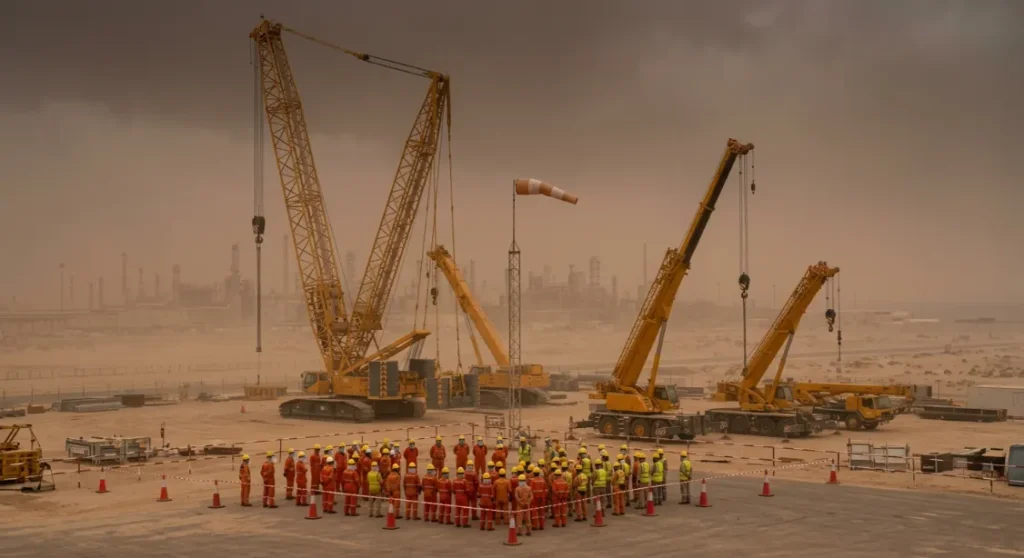
Each load chart is valid only up to a stated wind speed. Crane makers tell operators to measure wind at the boom or jib tip, where it is often stronger than at ground level. Loads with a large flat face, such as panels, ducts or vessels, catch more wind and need a lower limit. Jubail also sees the shamal, a strong north-westerly wind that can carry dust. Fit an anemometer at the boom tip and write the stop limit into the lift plan.
Heat and humidity
Summer heat on the coast strains engines, hydraulic oil, batteries and tyres. It also tires the operator and the people on the tag lines. Saudi Arabia bans outdoor work under direct sun from 12 noon to 3 pm between 15 June and 15 September each year. Plan major lifts for early morning, when air is cooler and often calmer. Give crews shaded rest breaks and water.
Salt air
Coastal air leaves salt on wire rope, sheaves, pins and hook blocks. Salt speeds up corrosion inside the rope, where it is hard to see. Inspect rope against the discard criteria in ISO 4309 and keep it lubricated. Ask for the latest rope inspection record before the crane leaves the yard.
What safety documents does a rented crane need in Jubail?
Plant gates in Jubail check the crane and the crew before any work starts. Expect to show a valid third-party inspection certificate, the load chart for the set-up in use, operator and rigger cards, rigging gear certificates, a lift plan and insurance. Your plant may ask for more.
| Document | What it shows the plant |
| Third-party inspection certificate and sticker | The crane passed a recent examination by an independent body |
| Load chart in the cab | Safe loads for the exact configuration on site |
| Load moment indicator test record | The safe load indicator and cut-outs work |
| Operator card | The operator is certified for this crane type and size |
| Rigger and signal person cards | The crew slinging and guiding the load is qualified |
| Rigging gear certificates and colour tags | Slings, shackles and hooks are inspected and in date |
| Lift plan | Crane position, radius, load, exclusion zone and stop limits |
| Daily pre-use checklist | The operator checked the crane before the shift |
| Insurance | Third-party cover while the crane works |
Many plants use a colour-code tag system for rigging gear that changes with each inspection period. Ask which colour is current before you mobilise. For the wider gate pack on excavators, trucks and other plant, see our guide to heavy equipment rental for Dammam and Jubail.
When does a crane lift become a critical lift?
A lift is usually classed as critical when it uses more than about 75% of the crane’s rated capacity, or when two or more cranes share the load. There is no single threshold. Each plant sets its own, and some use 90%. Lifts over live plant or near power lines are often critical whatever the weight.
Common triggers for a critical lift:
- The load is above the plant’s capacity threshold
- Two or more cranes share the load (a tandem lift)
- The load passes over running process units, pipe racks or occupied buildings
- People are lifted in a man basket
- The crane works close to overhead power lines
- The load has an unknown or shifting centre of gravity
A critical lift needs a written plan signed off by a competent lift engineer or supervisor. It should cover:
- Crane configuration and the load chart reference
- Load weight and centre of gravity
- Rigging design and sling angles
- Ground bearing check and mat design
- Wind stop limit
- Exclusion zone and radio communication
- Step-by-step lift sequence
- Names and roles of everyone on the lift
Cranes are often one part of a larger plant job. For the other machines on site, read our guide to equipment rental for petrochemical construction.
Who needs to be on site for a crane lift?
A safe lift needs a clear chain of roles. One lift supervisor runs the lift. A certified operator runs the crane. A rigger prepares and attaches the load. One signal person guides the operator. The plant’s permit issuer controls the work area.
| Role | Main duty |
| Lift supervisor | Owns the lift plan and stops work if anything changes |
| Crane operator | Runs the crane within the chart and the plan |
| Rigger | Selects, checks and attaches slings and shackles |
| Signal person | Gives the only signals to the operator |
| Permit issuer | Issues the permit to work and controls site access |
Hold a toolbox talk before the first lift of each shift. Keep one signal person only, so the operator never gets mixed instructions. Mark the exclusion zone with hard barriers, and keep everyone out from under the load.
How should you plan the crane hire timeline?
- Send the lift data: load weight, radius, hook height, dates and site rules.
- The supplier selects the crane and drafts a lift plan for your review.
- The paperwork pack goes to your plant for gate approval.
- The crane travels by road. Oversized loads move under a road permit, in daylight. From Riyadh, the trip to Jubail is about 500 km by highway.
- The crew sets up, checks the ground and runs pre-use checks.
- Lifting starts once the permit to work is signed.
- At the end, the crane is removed and final hours are agreed.
Renting a crane for your Jubail project
FSAK supplies operated mobile cranes from its own fleet. Each crane hire comes with an operator, a lift supervisor and a rigger, plus a lift plan for your site to review. We mobilise to the Eastern Province from our Riyadh base.
- Own fleet. Cranes come from our yard, not from a broker.
- Full lifting crew. Operator, lift supervisor and rigger on every crane hire.
- Ground work in-house. The same team can build crane pads and access roads.
- One contact for equipment, manpower and civil works.
- Arabic and English communication with your site team.
Crane hire sits alongside the civil and building work we deliver from Riyadh. You can also browse our full equipment rental fleet.
Want to see how our crews work? Look through recent FSAK projects, or read more about FSAK Contracting.
Planning a lift in Jubail? Send us the load weight, radius, hook height and dates. We will reply with a crane option, a draft lift plan and a price.
Frequently asked questions
What size crane do I need for a lift in Jubail?
Size the crane on the load at your working radius, not on its headline tonnage. Add the rigging weight to the load. Then pick a crane whose chart covers that total at your radius and boom length, with a margin below your plant’s critical lift threshold.
Do FSAK cranes come with an operator?
Yes. FSAK supplies its cranes with a certified operator, plus a lift supervisor and rigger on every crane hire. The crew works under your site’s permit to work system and plant rules.
What wind speed stops crane work?
There is no single figure. Each load chart states the maximum wind speed it allows, measured at the boom tip. Loads with a large surface area need a lower limit. Your lift plan should set the stop limit for that lift.
Is a lift plan needed for every crane lift?
Most industrial plants want a written lift plan for every crane lift. Routine lifts can use a standard plan. Critical lifts need a detailed plan with load calculations, ground checks and signed approval.
Can a crane work safely on sabkha ground?
Yes, with the right preparation. Sabkha is weak, so outriggers need large mats or a compacted crane pad. Check the ground at each outrigger position before set-up, especially after rain or when the water table is high.