A forklift rated at three tonnes will not always lift three tonnes. The number painted on the counterweight is a starting point, not a promise. Load shape, lift height and any attachment fitted to the carriage all pull that figure down.
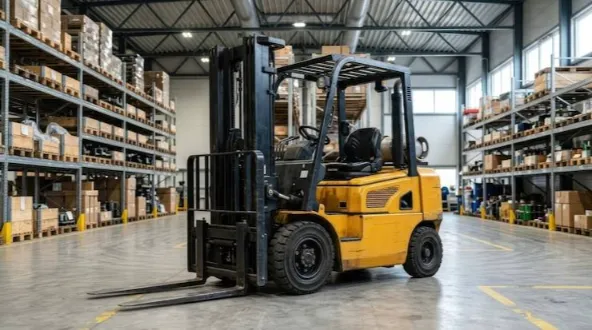
Getting this wrong is expensive. A truck that tips, a pallet that drops, or a hired machine that cannot finish the job all cost more than the hire itself. This guide explains how forklift capacity is set, what reduces it, and how to size a lift truck before you book one.
What forklift capacity actually means
Forklift capacity is the maximum weight a truck can lift safely at a stated load centre and lift height. Manufacturers call this the rated capacity. It is tested under set conditions, with a compact load sitting squarely on the forks. Change those conditions and the safe weight changes with it.
The physics is simple. A counterbalance forklift works like a seesaw. The front axle is the pivot. The load sits on one side and the counterweight sits on the other. Tip the balance too far forward and the rear wheels lose grip.
Engineers describe the safe zone as the stability triangle. It runs between the two front wheels and the centre of the rear axle. While the combined centre of gravity of truck and load stays inside that area, the machine is stable. Push it outside and the truck starts to go over.
How to read a forklift data plate
Every forklift carries a data plate, usually fixed near the operator seat. It is the only authoritative source for that machine. Treat a missing, painted over or illegible plate as a reason to reject the unit.
The plate tells you:
| Field | What it tells you |
|---|---|
| Model and serial number | Identifies the exact machine, not the model family |
| Rated capacity | Maximum load at the stated load centre and height |
| Load centre | The distance the rating assumes, commonly 500 mm, with 600 mm used in some markets |
| Maximum fork height | The highest the forks go, which is not always the height you keep full capacity at |
| Truck weight | Needed for floor loading, slab checks and transport planning |
| Attachment details | Any fitted attachment should appear here with a revised capacity |
| Tyre type | Solid, pneumatic or cushion, which affects where the truck can work |
Read the plate as a table, not a single number. Most plates show capacity falling as height and load centre rise.
Why the load centre changes the number on the plate
The load centre is the horizontal distance from the face of the forks to the centre of gravity of the load. Ratings assume a neat, evenly packed load that sits close to the mast.
Long loads break that assumption. Timber lengths, pipe runs, sheet material and bundled rebar all push their weight further out. The further the weight sits from the mast, the harder it pulls on the front axle.
A useful rule of thumb is that doubling the load centre roughly halves the capacity. It is an approximation, not a calculation. Here is how that behaves in practice on a notional three tonne truck:
| Load centre | Indicative safe load | Typical load type |
|---|---|---|
| 500 mm | 3,000 kg | Standard pallet, packed tight |
| 750 mm | Around 2,000 kg | Deep pallet or stacked bagged goods |
| 1,000 mm | Around 1,500 kg | Long timber, pipe sections, sheet stacks |
| 1,200 mm | Lower again | Oversized or overhanging loads |
Those figures illustrate the pattern. The plate on the machine you hire is the figure that counts. Where your real load centre falls between two values on the chart, work to the lower one.
Uneven loads matter as well. A pallet loaded heavy at the back is not the same as one loaded heavy at the front, even at identical total weight.
How lift height cuts into capacity
Capacity at ground level is rarely capacity at full height. As the mast extends, the load sits higher and the combined centre of gravity rises. The truck becomes easier to tip, so the safe figure drops.
The remaining figure at a given height is called residual capacity. On tall mast machines the gap between rated and residual capacity is wide. A truck that handles its full rating at two metres may handle noticeably less at six.
Racking work is where this bites. Teams often size a truck on pallet weight alone, then find the top beam level out of reach at that weight. Always size on the heaviest load at the highest point it has to reach.
What attachments take away from your lift
Attachments reduce capacity twice over. The attachment has its own weight, which the truck must carry before it touches your load. It also sits in front of the carriage, which pushes the load centre forward.
- Side shift: modest effect, often the smallest penalty of the common attachments
- Fork positioners: small to moderate, depending on build
- Fork extensions: significant, because they move the load well forward
- Clamps and rotators: significant, both in weight and in forward reach
Any fitted attachment should come with a revised capacity shown on an updated plate. If an attachment is bolted on and the plate still reads as it did from the factory, stop and ask. That gap is a common finding on poorly maintained hire fleets, and it is one of the questions worth putting to any supplier before delivery.
Capacity classes and the work each one suits
Capacity bands give you a quick starting point. Confirm the exact unit against your load before anything is booked.
| Class | Typical work |
|---|---|
| Light, up to around 2 tonnes | Stockrooms, shelf work, light indoor pallets |
| Mid range, around 2.5 to 3.5 tonnes | Everyday site and warehouse pallets, the most common hire |
| Heavy, around 5 to 7 tonnes | Structural steel, pipe sections, bulk bagged material |
| Very heavy, 10 tonnes and above | Plant sections, large modules, concrete elements |
Fuel type sits alongside capacity. Diesel units suit open ground and long shifts. Electric units suit enclosed work where exhaust and noise are a problem. Our forklift hire page sets out how both options are supplied, with an operator or on bare hire.
Six checks before you confirm a forklift size
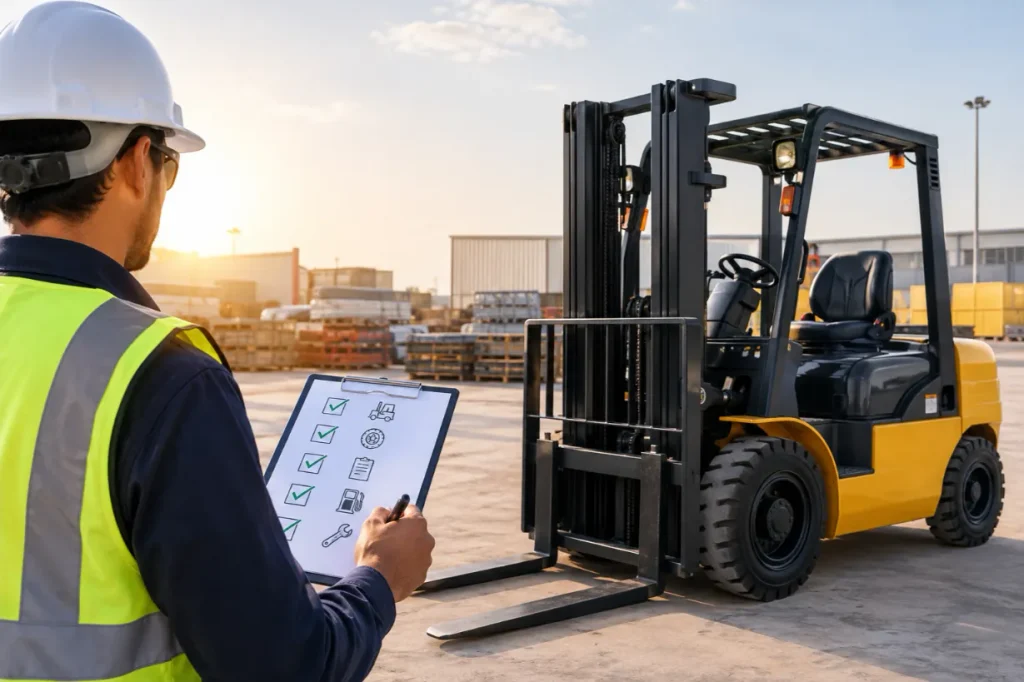
- Weigh the heaviest load, do not estimate it. Packaging, pallets and moisture all add weight people forget.
- Measure the load centre. Measure from the fork face to the middle of the load, on the heaviest item you will handle.
- Set the real lift height. Use the highest point the load must reach, not the average.
- List every attachment. Then ask for the derated plate figure, in writing.
- Check the ground and the doorways. Tyre type, slab loading, slopes and headroom all narrow the shortlist.
- Add working margin. Sizing a truck to its exact limit leaves nothing for an awkward load or a tight turn.
Teams planning a full site setup usually run these checks alongside access routes and laydown areas, which the engineers on our contracting team handle as part of site planning.
Capacity mistakes that cause damage on site
Sizing on pallet weight alone. Lift height and load centre are left out, so the truck runs out of capacity at the beam.
Reading the model name as the rating. A badge is marketing. The plate is engineering.
Mixing attachments between machines. Moving a clamp from one truck to another carries over nothing. Each pairing needs its own rated figure.
Adding counterweight informally. Weighting the rear to lift more is dangerous and voids the rating.
Treating a near miss as a pass. A load that lifts while the rear wheels go light was never safe. It was lucky.
Sites that handle mixed loads often take one larger truck rather than two mid range units. It is usually cheaper than a second mobilisation, and it gives headroom when a load comes in heavier than the drawing said. Other machinery on the same programme can be covered on the same hire ticket through our equipment rental service, which keeps delivery and collection on one schedule.
Frequently asked questions
What does rated capacity mean on a forklift?
Rated capacity is the maximum load the truck can lift at the load centre and lift height stated on its data plate. It assumes a compact, evenly packed load. Real conditions usually reduce the safe figure below it.
What is a forklift load centre?
The load centre is the distance from the fork face to the centre of gravity of the load. Ratings are commonly quoted at 500 mm, with 600 mm used in some markets. Loads that sit further out reduce capacity sharply.
Does lift height reduce forklift capacity?
Yes. As the mast rises, the combined centre of gravity rises with it and the truck becomes less stable. The figure available at a given height is the residual capacity, and it is shown on the data plate chart.
Should I size the forklift to the exact weight of my load?
No. Leave working margin. Loads arrive heavier than drawings suggest, and tight sizing removes the buffer that keeps lifts safe when conditions change.
Can I lift more by adding weight to the back of the forklift?
No. Informal counterweighting changes the stability the machine was tested to and puts the operator at risk. If the load exceeds the rating, the answer is a larger truck.
Get the Right Forklift for Your Load
Send us the heaviest load, the lift height and the ground conditions, and we will tell you which capacity fits before anything is booked. FSAK Contracting has supplied plant and crews to project teams for over 20 years, with forklifts drawn from our own fleet on daily, weekly or monthly terms, operated or bare.