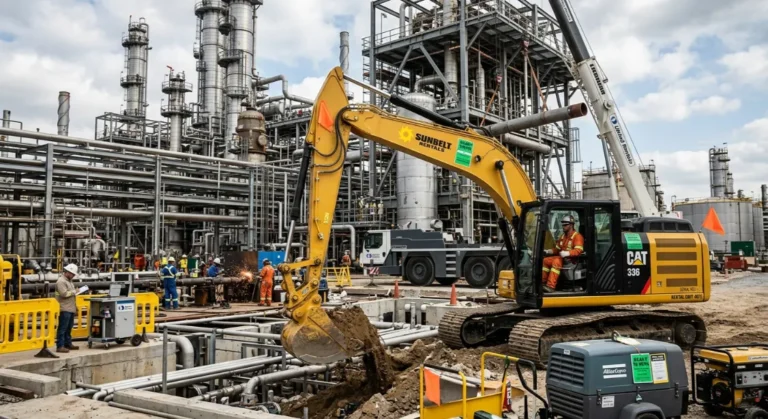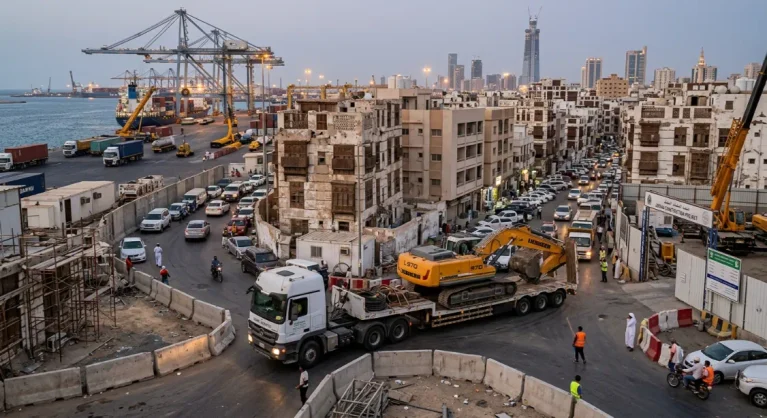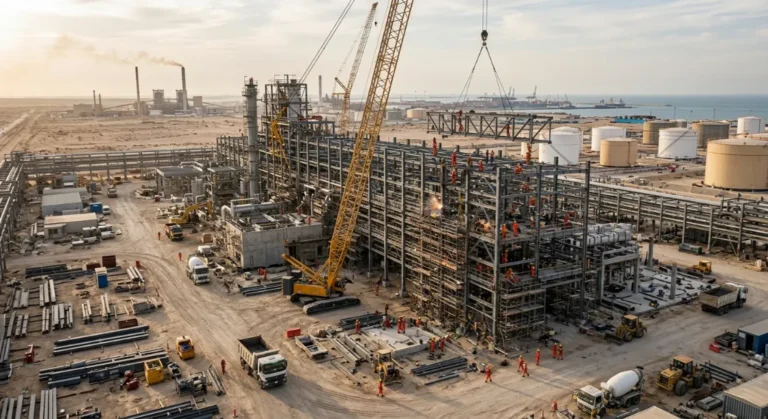
Oil and gas construction in Dammam rarely means building the plant itself. More often it means the civil work around it: access roads, laydown yards, utility tie-ins and support buildings. All of that sits next to live hydrocarbon assets. That shared boundary brings three layers of rules. The facility owner’s contractor safety rules come first. Industrial security and fire protection directives apply at regulated facilities. National labour and building rules apply to every site.
This guide explains how those rules fit together for oil and gas construction in Dammam. It also lists the documents a procurement team should ask for before a contractor sets foot on site.
Table of Contents
What counts as oil and gas adjacent construction in Dammam?
It is civil or enabling work that sits close to, connects into, or supports an oil, gas or petrochemical asset. The work is not process work. But the site shares risk with the plant next door. So the owner’s safety rules follow the contractor over the fence, even for a simple trench or boundary wall.
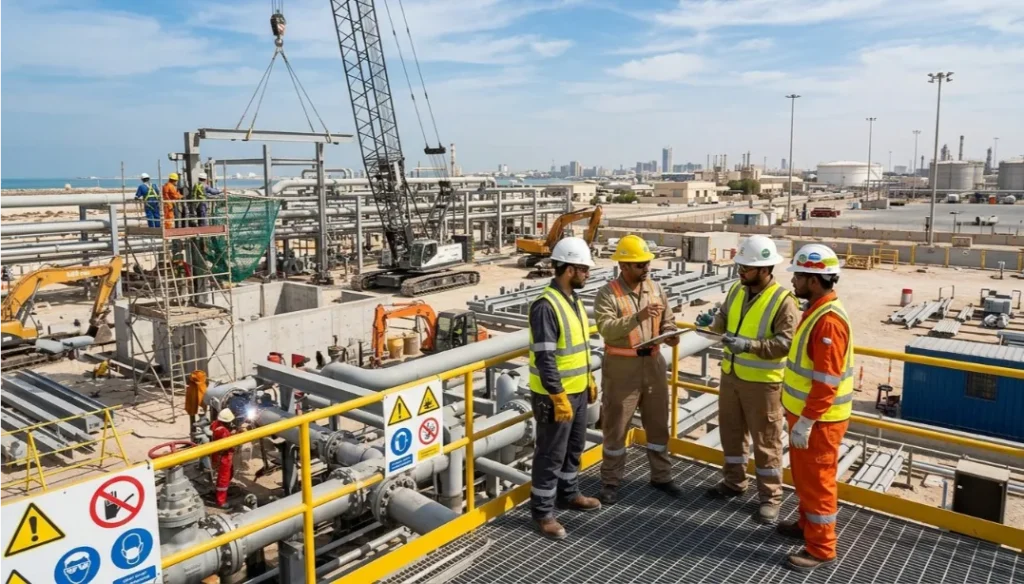
Typical scopes include:
• Site grading, fill and compaction for laydown yards and temporary camps.
• Access and haul roads to wellsites, plants and pipeline corridors.
• Utility installation for water, drainage, power and telecom lines that tie into plant networks.
• Foundations, boundary walls and support buildings on or beside industrial plots.
• Road and trench crossings over or under existing pipelines.
Why the workload around Dammam keeps growing
Dammam sits at the centre of the country’s energy industry, and new gas and oil capacity is still being added across the region. Every new plant needs roads, yards, utilities and labour around it. That supporting work keeps civil contractors in Dammam busy. It is also where most of the safety exposure for non-process contractors sits.
Which safety rules apply on these sites?
No single rulebook covers every site. The facility owner’s contractor rules apply on its land and projects. Security and fire protection directives apply at regulated industrial facilities. National labour and building rules apply everywhere. A sound HSE plan maps each rule to the scope before mobilisation, not after the first audit.
| ule layer | Typically applies to | What it changes on site |
|---|---|---|
| Facility owner’s contractor safety requirements | Contractors working on the owner’s sites and projects | An approved project HSE plan before work starts, HSE staffing set by risk level, and monthly safety reporting |
| Owner’s construction safety manual and site handbook | Facility sites, project sites and laydown yards | Detailed rules for excavation, lifting, scaffolding, roadworks and permits |
| Industrial security and fire protection directives | Regulated petroleum, industrial and utility facilities | Formal work permit systems, pipeline safety rules and approved fire protection contractors |
| National summer midday work ban | All private sector outdoor work | No work under direct sun during peak hours in the summer months |
| National building code and fire safety approvals | Permanent buildings and structures | Design, fire safety and occupancy sign-off |
When two requirements conflict, the owner’s specific instruction or engineering standard usually takes priority over a general manual. Always confirm the order of precedence in writing at contract stage.
HCIS has an Eastern Province branch in Jubail covering the province, Jubail Industrial City and Ras Al Khair. It oversees security, safety and fire protection across 13 strategic sectors (Saudipedia).
How does the permit to work system control risk?
A permit to work is a written approval for one task, at one place, for a set period. It confirms that hazards are isolated, gas is tested and the crew is briefed. On oil and gas adjacent sites, no valid permit means no work. That applies to routine jobs like digging a cable trench.
Most facility owners run separate permits for:
hot work
cold work
confined space entry
equipment opening or line breaking
excavation
A permit on paper is not proof of a safe job. The supervisor must check that the real ground, crew, equipment and isolations match what the permit describes. When conditions change, the work stops and the permit is revalidated.
What makes excavation near live pipelines different?
Buried lines lower the trigger for formal controls. On most facility sites, a shallow trench that would be routine elsewhere needs a checklist and permit if pipelines or cables may be nearby. Deeper cuts need an engineered design for sloping, benching or shoring. Deep excavations may also be treated as confined spaces.
Ground conditions add a local layer. Low-lying coastal ground often includes sabkha, a salt-crusted soil that loses strength when wet. Trench walls in these soils need closer inspection, especially after rain or dewatering.
A safe digging sequence near buried lines
- Collect as built drawings and utility records from the asset owner.
- Locate and mark every line with detection equipment before machines arrive.
- Complete the pre excavation checklist and get the excavation permit signed.
- Expose lines by hand or vacuum excavation before any mechanical digging close to them.
- Slope, bench or shore to the approved design and keep spoil back from the edge.
- Inspect the excavation every shift and after any change, then record.
FSAK plans this sequence into every earth and enabling works package that runs close to buried services.
How does summer heat change the site plan?
On Gulf coast sites, humidity adds to the strain. In practice, compliant programmes use:
• Early starts, with heavy tasks finished before late morning.
• Night shifts for concrete pours, with proper lighting and fatigue controls.
• Shaded rest areas, cool drinking water and scheduled breaks.
• Buddy checks and supervisor watch for signs of heat illness.
What should procurement teams check before appointing a contractor?
Check evidence, not promises. Ask for the documents that prove a contractor can run an owner-compliant site from day one. Most facility owners prequalify contractors on HSE capability before they can bid. Past safety performance, usually over several years, carries real weight at award.
| What to request | Why it matters |
|---|---|
| Prequalification status with the facility owner | Confirms the contractor may bid and work on the owner’s land |
| Draft project HSE management plan | Most owners require an approved plan before work starts |
| HSE staff CVs and certificates | Owners check HSE staffing levels and recognised qualifications |
| Three years of incident and man-hour statistics | Past performance is weighed at contract award |
| Plant and lifting equipment inspection certificates | Uninspected equipment is refused at the gate |
| Workforce records: valid residency, social insurance registration, medical fitness, site inductions | Unverified workers cannot be badged onto controlled sites |
| Method statements and risk assessments for each hazard | Gaps are a common audit finding and can trigger stop-work orders |
The same checklist works when you shortlist construction contractors in Riyadh or anywhere else in the Kingdom. Only the owner rules change.
How does FSAK support oil and gas adjacent projects in Dammam?
FSAK Contracting delivers the civil side of oil and gas construction in Dammam. That covers earthworks, access roads, utility installation, manpower and owned heavy equipment. We mobilise to Dammam and the wider Eastern Province from our Riyadh base. Our crews work under the client’s permit and HSE system.
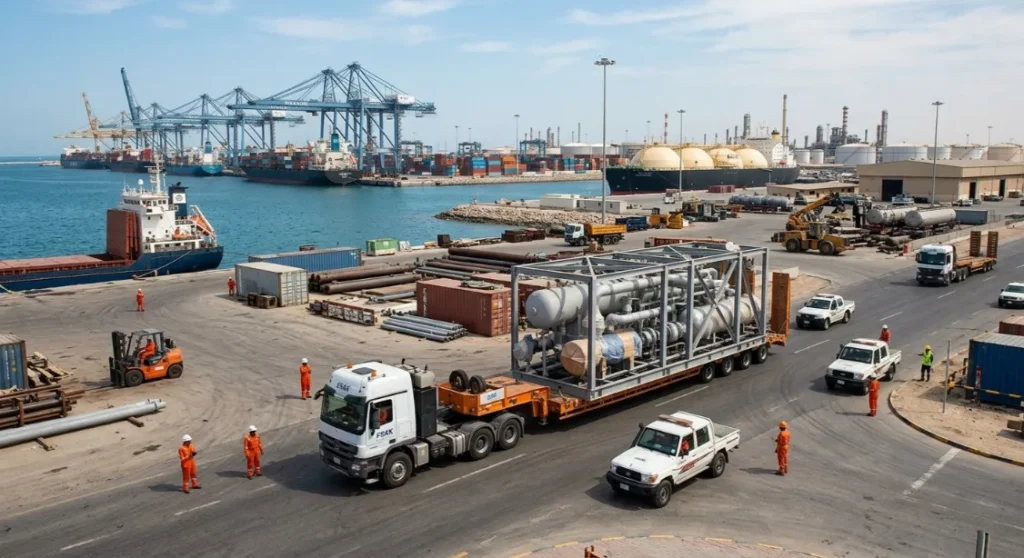
We work as one of the construction contractors in Dammam that industrial clients bring in for enabling and support scope. Process piping, instrumentation and safety systems stay with specialist EPC contractors. We work alongside them, not in their place.
Every project is planned and resourced by our head office contracting team in Riyadh. Owning our fleet means excavators, graders and rollers arrive with inspection records ready for gate checks.
Where a client needs extra hands, our manpower supply across Saudi Arabia comes with documented Iqama, GOSI and induction records.
Short term machine needs are covered through equipment rental with operators if required.
Frequently asked questions
Why are safety rules stricter near oil and gas facilities?
The main hazards come from the facility, not the civil task itself. Flammable gas, pressurised lines and buried pipelines can turn a routine job into a serious incident.
What is the next big project in Saudi Arabia?
Expo 2030 in Riyadh and the 2034 FIFA World Cup now top the national investment list. In February 2026, the investment minister said these fixed deadline events take priority.
What is oil and gas adjacent construction?
it is civil or enabling work built beside, around or in support of a live oil, gas or petrochemical facility. Typical scopes include access roads, laydown yards, utility tie ins, boundary walls and support buildings. The work is not process work. But it shares risk with the plant next door, so the facility’s safety rules apply to the civil contractor too
How does extreme heat affect construction schedules on facility sites?
Extreme heat moves the working day rather than stopping it. Heavy tasks shift to early mornings, and concrete pours often move to night shifts with proper lighting and fatigue controls. Shaded rest areas, cool drinking water, scheduled breaks and buddy checks help prevent heat illness.
Plan your next Eastern Province scope with FSAK
Planning civil works near a live facility? Share your scope, drawings and the owner’s HSE requirements. Our project team will review them and reply with a method statement outline and a quotation.