Saudi Arabia’s giga projects represent the largest coordinated construction effort in modern history. Developments such as NEOM, Qiddiya, the Red Sea Project, and The Line require tens of thousands of workers deployed across remote, often undeveloped terrain, with compressed timelines and strict regulatory oversight. Managing construction manpower on Saudi giga projects is not simply a matter of hiring enough workers. It demands structured workforce planning, phased deployment, trade-specific skill matching, continuous productivity monitoring, and full compliance with Saudi labour regulations, including Saudisation, GOSI contributions, and Wage Protection System (WPS) requirements.
This guide explains how project owners, EPC contractors, and manpower supply companies can plan, deploy, and manage construction workforces on the Kingdom’s most complex sites.
Table of Contents
Understanding Manpower Requirements on Saudi Giga Projects
Before a single worker arrives on site, the manpower requirement must be defined with precision. Giga projects are characterised by overlapping phases, multi-package contract structures, and the simultaneous deployment of several subcontractors. Getting the workforce count, skill mix, and mobilisation timeline wrong at this stage creates delays that cascade through the entire programme.
Workforce Planning by Project Phase
Construction manpower demand on a giga project follows a predictable curve. During the earth and enabling works phase, the requirement is weighted towards heavy equipment operators, surveyors, and general labourers. As the project transitions into structural and civil works, demand shifts to steel fixers, formwork carpenters, concrete technicians, and crane operators. The finishing phase calls for MEP technicians, tilers, painters, and fit-out specialists. A well-prepared manpower loading chart, typically produced alongside the project S-curve in tools such as Primavera P6, ensures that workers are mobilised ahead of each phase rather than reactively recruited after delays have already begun.
Identifying Skilled and Specialised Workers
Giga project specifications often exceed standard Saudi building code requirements. NEOM, for example, mandates advanced sustainability certifications and BIM-integrated workflows that require workers trained in specific installation methods. Identifying these specialised trades early, and distinguishing them from general skilled and unskilled categories, allows procurement teams to source manpower from qualified suppliers with verified trade competency rather than relying on volume-based recruitment.
Estimating Workforce Demand
Workforce demand estimation on giga projects is driven by the bill of quantities (BOQ), the master programme, and productivity norms adjusted for Saudi site conditions. Heat restrictions during summer months (typically a midday outdoor work ban from June to September) reduce effective working hours by approximately 20 to 25 percent. Remote locations such as Trojena, AMAALA, and Sindalah add further logistical overhead for worker transport and rotation. These factors must be built into the demand calculation from the outset, not treated as variances after the baseline is set.
How to Plan and Deploy Construction Manpower
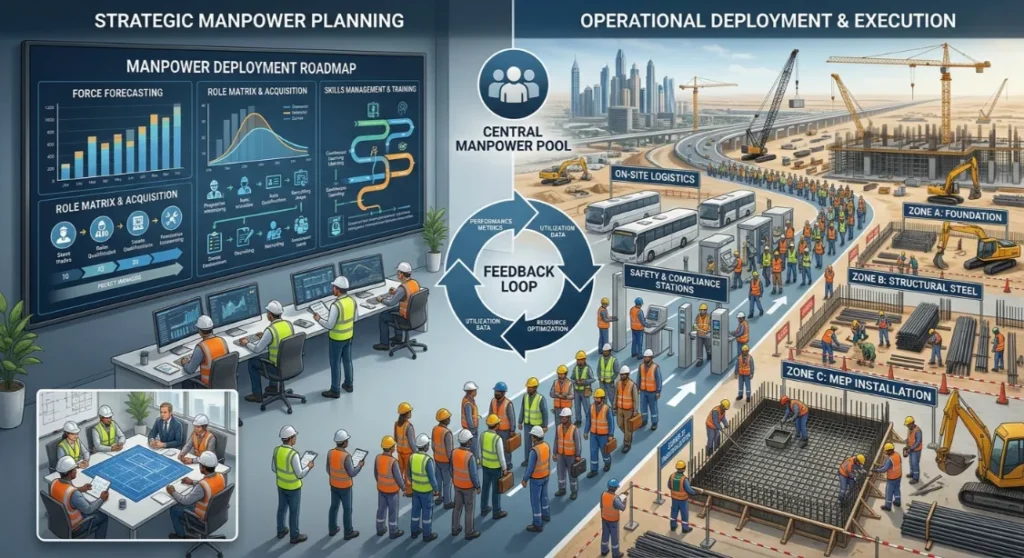
Deployment planning for giga projects operates at a scale that distinguishes it from conventional project staffing. A single NEOM sub-zone may require 5,000 to 15,000 workers across multiple trades, accommodated in purpose-built camps and transported on dedicated bus fleets.
Creating a Manpower Deployment Plan
The deployment plan maps each trade category to a specific mobilisation date, accommodation allocation, transport route, and reporting line. It is typically produced by the project controls team in coordination with the manpower supplier and updated weekly as the programme evolves. On Vision 2030 projects, this plan is often contractually required as a deliverable during the pre-construction phase, and it is reviewed by the client’s project management consultant (PMC) before mobilisation is authorised.
Assigning Workers Based on Skills and Experience
Giga projects cannot afford to treat workers as interchangeable units. A skill matrix is used to match each worker’s verified trade certification, years of experience, and previous giga project exposure to the specific package they are assigned to. Workers with prior NEOM or Red Sea Project experience, for instance, are already familiar with the client’s HSE protocols and access control systems, which reduces induction time and accelerates productive output.
Managing Shifts, Attendance, and Workforce Allocation
Most giga project sites operate on two-shift or split-shift models to maximise productive hours within heat restriction windows. Digital attendance systems using biometric scanners or RFID cards are standard, with data feeding into centralised workforce dashboards. These systems are not optional extras. On projects governed by PMCs such as Bechtel, AECOM, or Jacobs, daily attendance data is a contractual reporting requirement linked to progress payment certification.
Managing Construction Workforce Productivity
On giga projects, even a small productivity shortfall per worker multiplies across thousands of personnel to produce significant programme delays. Productivity management is therefore treated as a continuous control function, not a periodic review.
Setting Workforce Productivity Targets
Productivity targets are set against industry norms adjusted for Saudi conditions. For example, a concrete crew’s output in cubic metres per shift is benchmarked differently during summer months than during the cooler period from November to February. These targets are agreed with the subcontractor during the pre-mobilisation meeting and form the basis of earned value calculations used to assess whether the workforce size needs to be increased, maintained, or reduced.
Monitoring Worker Performance
Performance monitoring on giga projects combines daily supervisor reports with weekly productivity analysis. The site engineer records output quantities per crew per shift, which are compared against the planned quantities from the baseline programme. Underperforming crews are flagged within 48 hours, and corrective action, whether retraining, crew restructuring, or replacement by the manpower supplier, is initiated before the variance affects the critical path.
Reducing Idle Time and Labour Inefficiencies
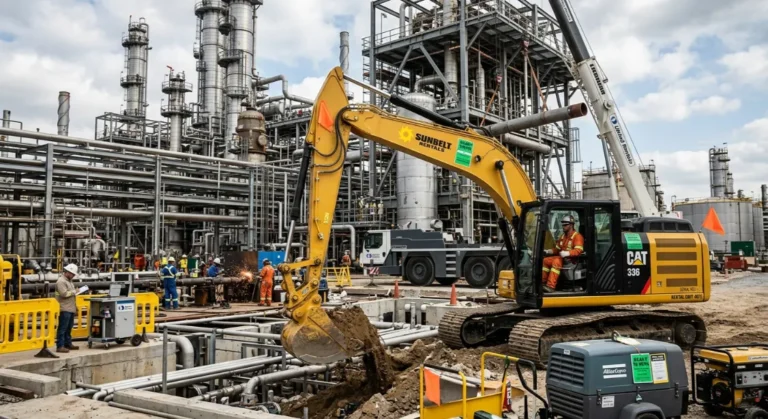
Idle time on giga projects is commonly caused by material delivery delays, permit-to-work bottlenecks, incomplete design information, and equipment breakdowns. Reducing it requires coordination between the main contractor, the manpower supplier, the equipment provider, and the design team. Pre-shift planning meetings, where the next day’s activities are confirmed against material availability and permit status, are the most effective tool for cutting non-productive hours. Contractors that operate their own equipment fleet have an additional advantage here, as machine availability is controlled internally rather than dependent on a third-party rental schedule.
Health and Safety Management for Construction Workers
Health and safety on gigaprojects are governed by project-specific HSE plans that supplement Saudi national requirements. Incident reporting, near-miss tracking, and lost-time injury (LTI) metrics are monitored at site, package, and programme level.
HSE Training and Site Safety
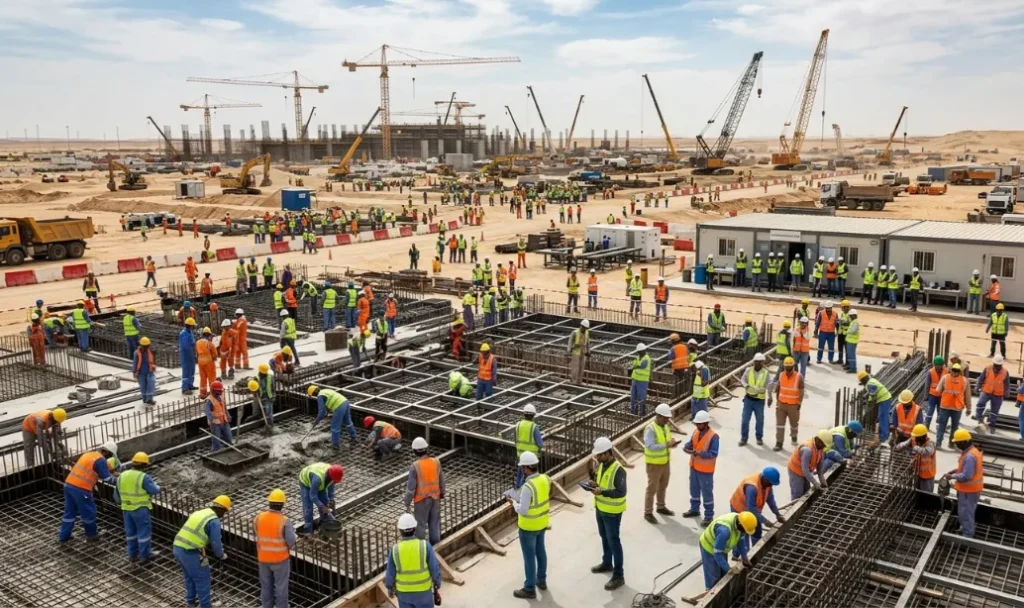
All workers complete a project-specific HSE induction before being granted site access. This is followed by trade-specific toolbox talks conducted daily before each shift. Topics rotate on a scheduled calendar and cover confined space entry, working at height, excavation safety, hot works permits, and electrical isolation procedures. Records of attendance and competency assessments are maintained digitally and are subject to client audit.
Managing Heat Stress and Extreme Weather
The Saudi midday work ban prohibits outdoor work during specified hours in summer. Beyond this regulatory requirement, best-practice contractors implement heat stress protocols that include hydration stations, shaded rest areas, buddy-system monitoring, and wet-bulb globe temperature (WBGT) measurement to determine whether conditions are safe for specific activities. On desert and coastal giga project sites, wind-borne sand and dust further affect visibility and respiratory safety, requiring additional PPE and activity restrictions during severe weather events.
PPE and Emergency Procedures
PPE requirements on giga projects typically exceed national minimums. Hard hats, high-visibility vests, steel-toe boots, safety glasses, and gloves are standard. Trade-specific PPE such as harnesses for work at height, respiratory protection for confined spaces, and arc-flash protection for electrical work is issued and inspected before each shift. Emergency evacuation drills are conducted at scheduled intervals, and muster points, casualty collection points, and emergency vehicle access routes are clearly marked and maintained.
Managing Manpower Suppliers and Subcontractors
Most giga project contractors engage multiple manpower suppliers simultaneously. Managing them requires the same discipline applied to any critical subcontract: clear scope, defined KPIs, regular performance reviews, and contractual remedies for non-compliance.
Selecting Qualified Manpower Suppliers
Qualified manpower suppliers for giga projects are distinguished by three factors. They hold current commercial registrations and MHRSD licences, they maintain a ready pool of workers with verified trade certifications, and they have demonstrated experience in deploying large workforces to remote Saudi locations. Suppliers who can also provide workforce accommodation and transport as part of their package reduce the coordination burden on the main contractor.
Verifying Worker Skills and Certifications
Verification is not a one-time gate. Trade tests are conducted on arrival, and periodic re-assessment is built into the quality plan. On steel-intensive packages, for example, welders are tested against specific WPS (welding procedure specifications) before being assigned to production work, and their test coupons are retained as quality records. The manpower supplier is responsible for providing workers who pass these tests and for replacing those who do not.
Monitoring Subcontractor Workforce Performance
Weekly performance meetings between the main contractor and each manpower supplier review attendance rates, productivity output, HSE incident data, and mobilisation/demobilisation compliance. KPIs such as average attendance above 92 percent, LTI frequency rate below a defined threshold, and replacement response time within 72 hours are standard contract metrics. Suppliers who consistently fall below the threshold are placed on improvement plans and, if performance does not recover, are replaced.
Using Technology for Construction Manpower Management
Technology adoption on Saudi giga projects has accelerated considerably since 2023, driven by client mandates and the sheer impossibility of managing 10,000-plus workers with spreadsheets and paper registers.
Digital Attendance and Workforce Tracking
Biometric and RFID-based attendance systems are deployed at camp exits, bus boarding points, and site entry gates. These systems capture clock-in and clock-out times, calculate hours worked per individual, and flag anomalies such as workers present on site but not logged into any active work permit. The data feeds into payroll, into the Wage Protection System (WPS) for salary transfer compliance, and into the contractor’s resource-loaded programme for earned value reporting.
Real-Time Workforce Monitoring
GPS-enabled wearables and smart helmets are increasingly used on giga projects to track worker location in real time. This serves three purposes: safety (locating workers during an emergency), productivity (verifying that workers are in the correct zone for their assigned activity), and security (detecting unauthorised access to restricted areas). Real-time dashboards display workforce density maps that allow the site team to identify overcrowding in hazardous zones and rebalance deployments accordingly.
Data-Driven Manpower Planning
Historical data from previous project phases is used to refine manpower forecasts for upcoming phases. By analysing productivity rates, absenteeism trends, and trade-specific replacement lead times, project controls teams can produce more accurate manpower loading forecasts and reduce the cost of over-mobilisation or emergency recruitment.
Common Manpower Challenges on Saudi Giga Projects
Even with robust planning, giga projects face workforce challenges that are structurally different from conventional construction. Recognising these challenges early allows contractors and manpower suppliers to build contingency into their deployment models.
Skilled Labour Shortages
Saudi giga projects compete for a limited pool of specialised trades, particularly in categories such as tunnel boring machine (TBM) operators, BIM coordinators, and advanced MEP technicians. Multiple giga projects running concurrently across the Kingdom intensify this competition. Contractors that maintain long-term relationships with manpower suppliers and invest in worker retention, through competitive wages, welfare standards, and predictable rotation schedules, are better positioned to secure the trades they need.
Workforce Turnover and Mobilisation Delays
High turnover rates on remote giga project sites are driven by the challenging living conditions, long rotation cycles, and competition from better-paying packages offered by rival projects. Mobilisation delays are caused by visa processing backlogs, slow Iqama renewals, and the time required to source replacements for workers who fail trade tests. Building a 10 to 15 percent standby buffer into the manpower plan is standard practice for mitigating these delays.
Communication and Coordination Issues
Giga project workforces are multinational, with workers from South Asia, Southeast Asia, the Middle East, and Africa operating alongside Saudi nationals. Language barriers, cultural differences, and varying levels of construction experience create coordination challenges that are compounded by the scale of the operation. Multilingual toolbox talks, visual work instructions, and the use of bilingual supervisors (Arabic and English at minimum) are essential for maintaining safety and quality standards.
Changing Workforce Requirements
Design changes, client-directed acceleration, and programme resequencing are routine on giga projects. Each change alters the manpower requirement, sometimes dramatically. A flexible workforce model, combining a core team of directly employed workers with a scalable supply of outsourced manpower from qualified suppliers, allows contractors to respond to these changes without bearing the full cost of an oversized permanent workforce.
Best Practices for Efficient Construction Manpower Management
Plan Workforce Requirements in Advance
Begin manpower planning during the tender stage, not after contract award. Early engagement with manpower suppliers allows for competitive pricing, pre-mobilisation training, and the reservation of specialised trades before competitor projects absorb the available pool.
Maintain a Flexible Workforce
A ratio of approximately 70 percent outsourced manpower to 30 percent direct-hire is common on Saudi giga projects. This ratio provides stability through the core team while allowing rapid scaling through the supplier network as project phases ramp up or wind down.
Continuously Monitor and Adjust Manpower
Weekly manpower reviews, tied to the resource-loaded programme, are the control mechanism that prevents workforce drift. When planned versus actual headcount diverges by more than 10 percent for two consecutive weeks, the deployment plan is revised, and the manpower supplier is formally notified.
Prioritise Productivity, Safety, and Compliance
These three metrics are interdependent. A workforce that is compliant with Saudisation, GOSI, and WPS requirements avoids costly MHRSD penalties. A workforce that is trained in HSE reduces LTIs and avoids the programme disruption caused by safety stand-downs. A workforce that is productive delivers earned value on schedule and protects the contractor’s margin. None of these can be achieved in isolation, and all require the manpower supplier to be treated as a strategic partner rather than a commodity vendor.
FAQs About Construction Manpower in Saudi Arabia
How do you manage manpower on a construction project?
Manpower is managed through a structured process that includes workforce demand estimation from the BOQ and programme, trade-specific skill matching, phased mobilisation aligned to the construction schedule, digital attendance tracking, weekly productivity reviews, and continuous coordination between the main contractor and the manpower supplier. On giga projects, this process is governed by contractual KPIs and monitored by the client’s PMC.
What manpower is required for Saudi giga projects?
Saudi giga projects require a wide range of trades including heavy equipment operators, surveyors, steel fixers, formwork carpenters, concrete technicians, crane operators, MEP technicians, welders, scaffolders, and fit-out specialists. Supervisory, HSE, and quality control roles are also essential, and Saudi nationals are typically placed in these positions to meet Nitaqat requirements. A single NEOM sub-zone may require between 5,000 and 15,000 workers across these categories.
How can construction companies improve workforce productivity?
Productivity is improved by setting measurable output targets per crew per shift, conducting pre-shift planning meetings to confirm material and permit availability, using digital tracking to identify and resolve idle time, maintaining equipment availability through an owned fleet rather than relying solely on third-party rental, and implementing a performance management framework with the manpower supplier that includes weekly reviews and contractual remedies for underperformance.
What are the biggest manpower challenges in the Saudi construction industry?
The primary challenges are skilled labour shortages (intensified by multiple giga projects competing for the same trades), workforce turnover on remote sites, visa and Iqama processing delays, heat restriction-related productivity losses during summer months, and the coordination complexity of managing multinational crews across large-scale, multi-package projects.
How does Saudisation affect construction manpower?
Saudisation under the Nitaqat system requires all contractors to employ a defined percentage of Saudi nationals. In construction, this is typically met through placements in supervisory, administrative, HSE, and quality control roles. Failure to meet Nitaqat quotas can result in visa processing restrictions, fines, and in some cases, suspension from giga project approved vendor lists. Experienced manpower suppliers maintain a pool of Nitaqat-ready Saudi personnel to help contractors meet their quotas without disrupting site operations.
Discuss Your Giga Project Manpower Requirements
FSAK Contracting provides construction manpower supply, deployment planning, and workforce management for Saudi giga projects and Vision 2030 developments. With over 20 years of operational experience, an owned equipment fleet, and a workforce scaled for large-site mobilisation, FSAK supports EPC contractors, developers, and government bodies across the Kingdom.
● Request a manpower deployment proposal
● Get a custom workforce and equipment quote
● Speak with the project team about your next mobilisation
Contact FSAK Contracting: +966 50 248 5888 | +966 55 056 4888 | Info@fsakcontracting.com