Saudi construction is still growing in 2026, but at a slower and more selective pace than the peak years. Market trackers expect real growth of roughly 2% to 3% this year, rising to around 4% a year from 2027 to 2030. Most of the money is going into infrastructure, transport, housing and utilities.
For contractors and developers, the work is there. What has changed is how you win it and how you deliver it. Cost control, available machines and enough skilled people on site now matter as much as the size of your bid.
This construction industry outlook Saudi Arabia 2026 guide brings together the latest market figures, spending signals and sector trends. We also explain what they mean in practice if you are planning a project, bidding for work or budgeting for equipment over the next 18 months.
Saudi Construction Market 2026 at a Glance
Here are the main numbers people in the industry are watching right now.
| Indicator | Latest figure |
|---|---|
| Market size, 2026 | About USD 82.8 billion |
| Expected market size, 2027 | About USD 86.3 billion |
| Real growth, 2026 | 1.8% to 3%, depending on the tracker |
| Average yearly growth, 2027-2030 | About 4.1% to 4.4% |
| Infrastructure share of the market | About 60% |
| Contract awards, Jan-Jul 2026 | 97 projects worth SAR 111.3 billion |
| Contract awards, Jan-Jul 2025 | 84 projects worth SAR 70.1 billion |
| Construction share of all jobs (Q2 2026) | 14.7% |
You will see different market sizes in different reports. That is normal. Each research firm counts the market in its own way. Some include repair and maintenance, some only count new building, and some add energy plants. One broader estimate put the 2025 market above USD 100 billion. So do not get stuck on one headline number. Watch the direction instead, and the direction is still up.
The contract award figure is the one we would pay most attention to. Awards in the first seven months of 2026 were about 59% higher in value than the same period in 2025. Contracts signed this year turn into site work, equipment demand and hiring over the following months. That points to a busy 2027 on the ground.
Construction Spending in KSA for 2026: Where the Money Is Going
Public spending is still the main engine of the sector. About 63% of construction activity is funded by public investment, according to Mordor Intelligence.
The 2026 national budget plans total spending of about SAR 1.3 trillion. Three lines matter most for construction:
Private Investment Is Growing Faster
Private money is the fastest-growing funding source, expected to rise at about 4% a year. Developers in housing, hospitality, logistics and data centres are putting in more capital, often alongside public partners.
Financing is getting tighter, though. Bank lending for real estate grew 6.4% year on year in early 2026. That is still growth, but it is slower than the 10.8% seen in the third quarter of 2025. In practice, private developers are being more careful. They want firm prices, clear timelines and contractors who can show they will finish on budget.
Building Industry Forecast for Saudi Arabia: Sector by Sector
Not every part of the market is moving at the same speed. Here is how the main sectors look for 2026 and 2027.
| Sector | Outlook 2026-2027 | Typical work for contractors |
|---|---|---|
| Infrastructure and transport | Largest share, about 60% of the market | Earthworks, roads, bridges, culverts, rail civil works |
| Residential | Fastest-growing, about 4.8% a year | Site preparation, utilities, internal roads, landscaping |
| Energy and utilities | Steady growth | Cable ducts, water and drainage networks, plant enabling works |
| Institutional (health, education) | Backed by large budget lines | Hospitals, schools, campuses, external works |
| Industrial and logistics | Growing with freight demand | Warehouses, yards, heavy-duty pavements |
| Commercial, tourism and data centres | Selective but active | Enabling works, special structures, utility connections |
Infrastructure and Transport
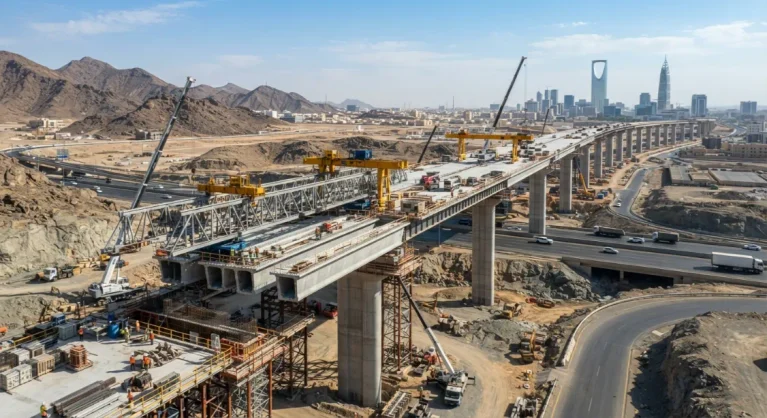
Roads, rail, ports and logistics hubs remain the biggest part of the market. The national rail network alone is planned to grow from about 5,300 km in 2024 to around 8,000 km by 2030. Every kilometre of new rail or highway needs earthmoving, drainage, utility diversions and bridges before anything else can happen.
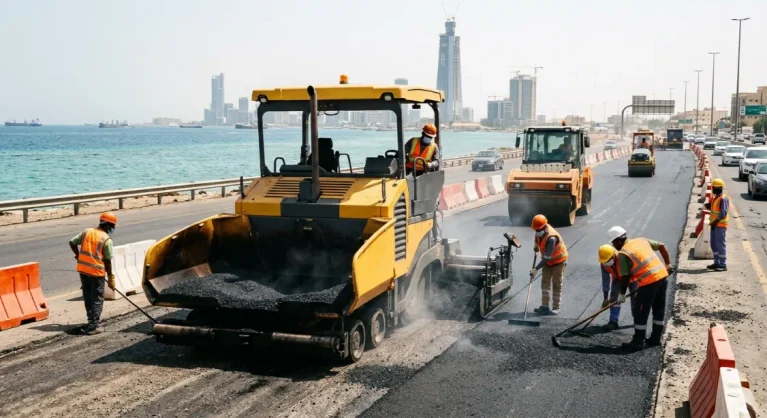
If you want to see how this plays out at city level, our article on urban road upgrades in Jeddah covers the contractor requirements in more detail.
Housing
Residential construction is forecast to grow the fastest of all segments. Cities are growing, and home ownership is a national priority. For contractors, new housing communities mean a lot of repeat work: plot grading, internal roads, water and sewer lines, street lighting ducts and green areas.
Energy, Water and Utilities
Saudi Arabia aims to produce half of its electricity from renewable sources by 2030. Solar and wind farms need large amounts of enabling works and cable trenching. Water security projects add pipelines, storage and drainage networks. This is steady work, but it comes with strict technical and safety requirements, so prequalification matters.
Data Centres, Logistics and Industrial
Data centres were named as one of the drivers of near-term growth in 2026. These projects move fast and need heavy power and cooling connections. Logistics parks and industrial yards also keep growing as freight capacity becomes a bigger focus.
Construction Sector Growth in KSA: Trends to Watch in 2026-2027
1. Fewer Awards, Bigger Packages
Owners are prioritising projects and awarding larger contract packages. Main contractors who win them then subcontract earthworks, utilities and finishing. For specialist contractors, this means more of the work now comes through tier-one contractors rather than straight from the owner.
2. Modular and Prefabricated Construction
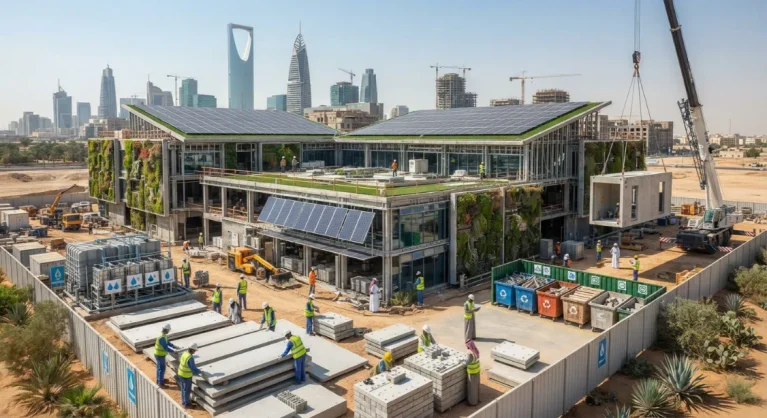
Modern methods such as prefabricated and modular building are expected to grow faster than any other construction method, at about 5.3% a year. They cut time on site and reduce the number of workers needed. Site preparation and foundations still have to be done properly, though, and the tolerances are tighter.
3. Pressure on Skilled Labour
Construction now accounts for 14.7% of all employment in the Kingdom, with more than 3.3 million insured workers in the sector by mid-2026. Even so, analysts list skilled labour shortages as the single biggest drag on growth. Operators, foremen, surveyors and experienced technicians are in short supply when several large projects mobilise at once.
4. Higher Costs and Financing Pressure
Cost inflation and higher borrowing costs are the second biggest risk in most forecasts. Contractors who priced jobs a year ago on old material and fuel rates are feeling it now.
5. Riyadh Leads, Other Cities Catch Up
Riyadh accounts for about 28% of construction activity. Jeddah and the Eastern Province (Dammam, Khobar and Jubail) are also busy with roads, housing, port linked logistics and industrial work. Projects outside Riyadh often face a different problem: getting machines and crews there on time.
6. More Contractors Renting Equipment
When money is expensive, tying up capital in machines that sit idle between contracts makes less sense. Renting excavators, rollers, cranes and lifts for the length of a contract keeps the balance sheet lighter and lets you match the fleet to each job. This is one reason heavy equipment rental demand tends to rise when project awards go up.
Material Prices and Cost Planning
We do not have a single reliable price index to quote for every material here, and prices for steel, cement, asphalt and fuel move during the year. What the forecasts agree on is that cost inflation is a real risk for 2026 and 2027 margins.
A few habits help:
- Ask suppliers for fresh quotes every quarter, not once at tender stage.
- Add a fair price escalation clause in contracts longer than 12 months.
- Lock prices for long-lead items early once the design is fixed.
- Compare the cost of renting equipment against buying for each project, not as a company-wide rule.
Labour Market Outlook for 2026-2027
Demand for site workers will stay high while big contract awards turn into active sites. Projects that start in the same region at the same time compete for the same pool of operators and skilled trades.
The practical answer for many contractors is a mix: a core in house team plus extra crews from a manpower supplier during peak phases. If you are planning work in the east, our guide on how to hire manpower in Dammam walks through what to check before you sign with a supplier. For projects in the capital, see our manpower supply in Riyadh service.
Opportunities for Contractors and Developers
For Main Contractors
- Line up reliable subcontractors for earthworks, utilities and landscaping before you bid, not after you win.
- Plan equipment and manpower for peak months so you are not paying spot rates.
- Keep project records and photos. Owners want proof of past delivery during prequalification.
For Developers and Project Owners
- Start site investigation and enabling works early. Delays at this stage push back everything else.
- Ask contractors for a clear equipment and manpower plan in their proposal.
- Build realistic cost buffers for 2027, given the inflation risk.
For Subcontractors and Suppliers
- Focus on the busiest segments: infrastructure, housing and utilities.
- Get prequalified with the main contractors who are winning large packages.
- Be ready to mobilise outside your home city, as the work is spread across the country.
Construction Industry Outlook Saudi Arabia 2026: What It Means for Your Project
The short version: the market is growing, the contract pipeline for 2027 looks strong, and the main risks are people, costs and timing. Projects that plan their site preparation, machines and workforce early are the ones most likely to stay on schedule.
FSAK Contracting is a Riyadh based construction and civil engineering company working on projects across Saudi Arabia. We support clients with earthworks and enabling works, road, bridge and tunnel works, utility installation, equipment rental and manpower supply. If you need an infrastructure contractor in Saudi Arabia, you can see the full list of our services or get in touch directly.
Frequently Asked Questions
How big is the Saudi construction market in 2026?
Mordor Intelligence values the Saudi construction market at about USD 82.8 billion in 2026, growing to around USD 86.3 billion in 2027. Other firms give higher figures because they include more types of work, such as maintenance or energy projects.
Is the Saudi construction sector still growing in 2026?
Yes. Real growth for 2026 is estimated at between 1.8% and 3%, which is slower than recent years. Growth is expected to pick up to about 4% a year between 2027 and 2030, supported by transport, energy, housing and tourism projects.
Which construction sector is the largest in Saudi Arabia?
Infrastructure is the largest, with about 60% of the market. This includes roads, rail, bridges, ports, airports and utility networks.
Which part of the market is growing the fastest?
Residential construction is forecast to grow the fastest, at about 4.8% a year. By construction method, modular and prefabricated building is growing fastest, at about 5.3% a year.
What are the main risks for construction projects in 2026-2027?
The biggest risks are shortages of skilled labour, rising material and financing costs, and delays in permits and approvals. Early planning for manpower, equipment and cost escalation reduces most of these risks.