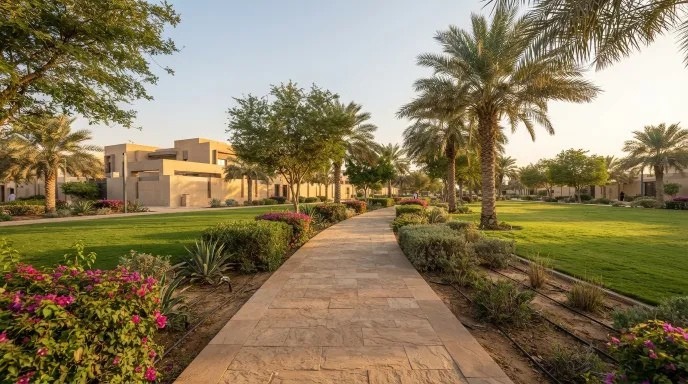
If your property sits close to the sea, the most reliable salt-tolerant plants for Jeddah are date palms, sea grape, tamarisk, oleander, Natal plum and seashore paspalum grass. They can take salty wind, salty soil and long humid summers without burning out after the first season.
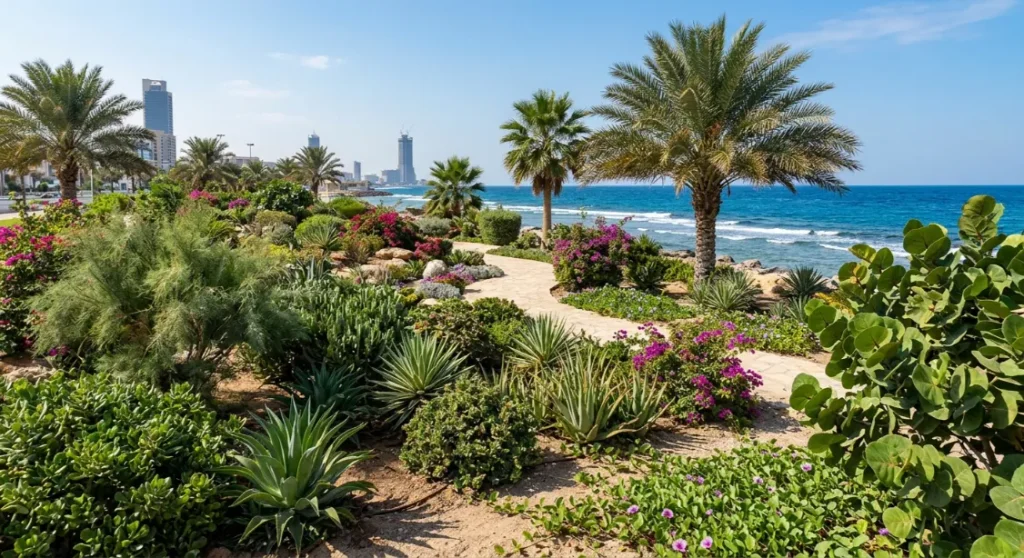
Most coastal gardens that fail in Jeddah fail for the same reason. Someone picks plants that look great at the nursery, plants them on the sea facing side, and a few months later the leaf edges turn brown and crispy. Owners often blame the water or the fertilizer. In most cases the real problem is salt.
Below we cover 18 plants that hold up near the coast, where each one works best in a garden, and the soil and watering steps that keep them alive.
Why Gardens Near the Sea in Jeddah Struggle
Salt reaches your plants in more than one way. Once you know which one you are dealing with, choosing plants gets much easier.
Salt spray carried by the wind
Sea breeze carries fine drops of salt water inland. When the drops dry on the leaves, the salt stays behind and draws moisture out of the leaf. You will usually see the damage on the side of the plant that faces the water. Villas and compounds in the first row along the coast get hit hardest.
Salty soil and a high water table
A lot of coastal ground around Jeddah is sandy or sabkha-type soil with salty groundwater close to the surface. In summer that water moves up, evaporates and leaves a white crust on top of the soil. Roots sitting in that layer have a hard time pulling in water, even when the soil feels wet. We explain this soil type in our guide to sabkha soil treatment for construction.
Salty irrigation water
Some properties water their gardens with well water or treated water that carries a fair amount of salt. Watering with it every day on soil that does not drain well means more salt is left around the roots each week.
Heat on top of everything else
Jeddah summers are long, hot and humid. A plant already stressed by heat copes with salt worse than it would in mild weather. That is why a shrub can look fine in winter and then collapse in July.
What Salt-Tolerant Really Means
Salt-tolerant does not mean salt-proof. Some plants can stand in the direct line of sea spray. Others only cope with a bit of salt in the soil and need shelter from the wind.
Garden designers usually split a coastal plot into three zones:
- Front zone: fully open to sea wind. Only high-tolerance plants go here.
- Middle zone: behind a wall, hedge or building. Some spray still reaches it.
- Sheltered zone: inner courtyards and gardens protected on all sides. Plants with medium or low tolerance can grow here.
The smart move is to use the tough plants to protect the softer ones.
Salt-Tolerant Plants for Jeddah: Palms and Trees
1. Date palm (Phoenix dactylifera)
The date palm is the safest choice for most coastal sites. It handles salty soil, salty water and drought, and it suits the local style. Use it along entrance roads, driveways and compound boundaries. When you buy large palms, check the trunk for small holes or oozing sap, which can be signs of red palm weevil.
2. Washingtonia palm (Washingtonia robusta)
This fan palm grows fast and takes salt spray well. It is a good pick for tall lines along long boundary walls or internal roads. It can grow over 20 metres, so keep it away from overhead cables.
3. Sea grape (Coccoloba uvifera)
Sea grape has large, round, leathery leaves and very high tolerance to salt spray. You can keep it as a dense shrub or let it grow into a small tree. It makes an excellent windbreak on the sea-facing side of a villa. Give it regular water until its roots settle.
4. Athel tamarisk (Tamarix aphylla)
Tamarisk is one of the toughest trees for salty ground. It grows fast and works well as a windbreak on large plots. Its roots spread wide, so plant it well away from pools, pipes and paving.
5. Ghaf tree (Prosopis cineraria)
The ghaf is native to the Arabian Peninsula. It sends roots deep, handles dry and moderately salty soil, and gives light, open shade. It grows slowly in the first couple of years, so it suits owners who plan long term.
6. Sidr tree (Ziziphus spina-christi)
Sidr is another native tree that copes with heat and some salt in the soil. It gives good shade once mature. The branches have thorns, so keep it away from walkways and children’s play areas.
Salt-Tolerant Shrubs and Hedges for Sea-Facing Gardens
7. Clerodendrum inerme (seaside clerodendrum)
This is one of the most common coastal hedges in the Gulf, and for good reason. It takes direct salt spray, trims into a neat hedge one to two metres high and has small white flowers.
8. Oleander (Nerium oleander)
Oleander flowers for most of the year and handles salt spray and poor soil. All parts of the plant are poisonous if eaten. Avoid it near play areas or where pets might chew it.
9. Natal plum (Carissa macrocarpa)
Natal plum has glossy leaves, white star-shaped flowers and red fruit. It has high salt tolerance and sharp thorns, which makes it a good security hedge along boundary walls and under ground-floor windows.
10. Pittosporum (Pittosporum tobira)
Pittosporum forms a dense, rounded shrub that handles salt spray well. Use it for low hedges and planting around building edges. It does not like waterlogged soil, so drainage matters.
11. Bougainvillea
Bougainvillea has medium salt tolerance. It does best in the middle zone, behind a wall or hedge. It loves full sun and actually flowers more when you water it less. Train it over pergolas, walls and gates.
12. Lantana (Lantana camara)
Lantana gives you bright colour in low beds and attracts butterflies. It handles a fair amount of salt. Its berries are toxic, and it can spread, so keep it trimmed.
Salt-Tolerant Ground Covers and Grass
13. Seashore paspalum (Paspalum vaginatum)
If you want a lawn near the sea, start here. Seashore paspalum handles salty soil and brackish irrigation water better than most lawn grasses, which is why hotels and coastal golf courses use it. It needs good drainage and regular mowing.
14. Bermuda grass (Cynodon dactylon)
Bermuda grass costs less and takes heavy foot traffic, so it suits play areas and parks. Its salt tolerance is lower than paspalum, so use it in the middle or sheltered zone.
15. Ice plant (Carpobrotus edulis)
Ice plant is a low succulent that copes with salt spray, sand and very little water. It spreads fast, so keep it inside edged beds.
Quick Comparison Table
| Plant | Type | Salt tolerance | Best zone | Water need | Good for |
|---|---|---|---|---|---|
| Date palm | Palm | High | Front | Low | Entrances, avenues |
| Washingtonia palm | Palm | High | Front | Low to medium | Tall boundary lines |
| Sea grape | Shrub or small tree | Very high | Front | Medium | Windbreaks, screens |
| Athel tamarisk | Tree | Very high | Front | Low | Windbreaks on large plots |
| Ghaf | Tree | Medium to high | Middle | Low | Light shade |
| Sidr | Tree | Medium | Middle | Low | Shade, native planting |
| Clerodendrum inerme | Shrub | High | Front | Medium | Clipped hedges |
| Oleander | Shrub | High | Front | Low | Flowering screens |
| Natal plum | Shrub | High | Front | Low to medium | Security hedges |
| Pittosporum | Shrub | High (spray) | Front or middle | Medium | Low hedges |
| Bougainvillea | Climber | Medium | Middle | Low | Walls, pergolas |
| Hopbush | Shrub | Medium to high | Middle | Low | Tall screens |
| Lantana | Shrub | Medium to high | Middle | Low | Colour beds |
| Seashore paspalum | Grass | High | Front or middle | Medium | Lawns on brackish water |
| Bermuda grass | Grass | Medium | Middle or sheltered | Medium | Play and sports areas |
| Sea purslane | Ground cover | Very high | Front | Low | Slopes, salty patches |
| Beach morning glory | Vine | Very high | Front | Low | Sandy edges |
| Ice plant | Succulent | High | Front | Low | Low-water beds |
These ratings are a general guide. How a plant actually does depends on your soil, drainage, water quality and distance from the shore.
Plants to Avoid or Use With Care Near the Sea
Some popular garden plants look good for a few months near the coast and then decline. Think twice before planting these on an exposed site:
- Conocarpus: it handles salt and grows fast, but its roots are known to crack pipes, paving and foundations. Many owners now pay to remove it. Keep it away from buildings and services.
- Ficus: similar root problems near walls and pipes.
- Hibiscus: a favourite in villas, but its leaves burn quickly in salt spray. Keep it in sheltered courtyards.
- Arabian jasmine, roses and gardenia: low salt tolerance. Grow them in pots or inner gardens with fresh water.
- Citrus and most fruit trees: sensitive to salty water and need good drainage.
- Cool-season lawn grasses such as ryegrass and fescue: they cannot handle Jeddah’s heat, let alone salt.
How to Plant and Care for a Coastal Garden in Jeddah
Picking the right plants is half the job. The other half is the ground they go into and how you water them.
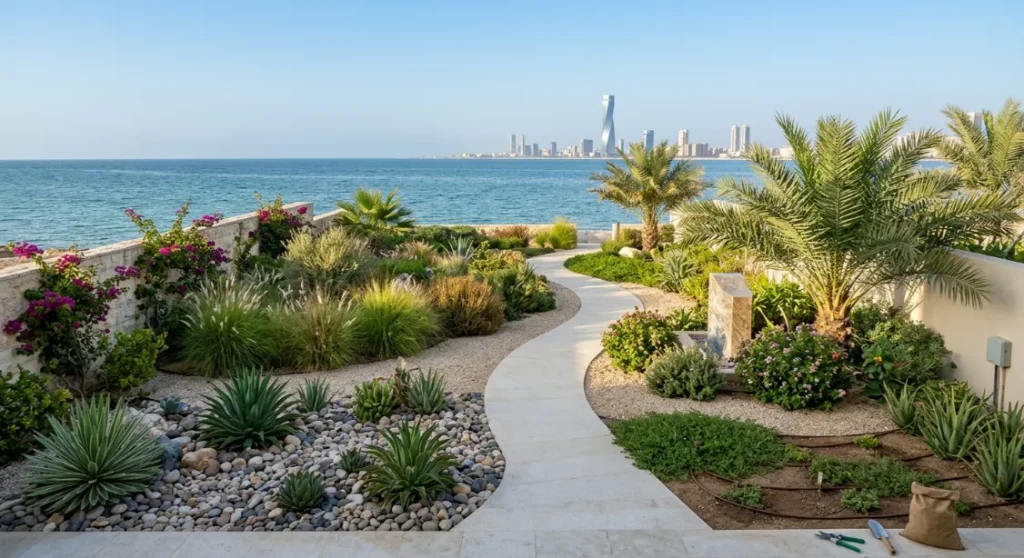
Fix drainage before planting
Most salt problems are really drainage problems. If water cannot move down and away, salt has nowhere to go. Break up hard layers, improve sandy soil with organic matter, add a gravel drainage layer under beds where needed, and lay subsurface drains on low-lying plots. On larger sites this starts with proper site preparation and grading so water runs where you want it.
Water deeply, not a little every day
Short daily watering wets only the top few centimetres. When it dries, salt is pulled back up toward the roots. Deeper watering, less often, pushes salt below the root zone. This is called leaching. On soil that drains well, a longer flush every few weeks helps keep salt down.
Use drip lines for trees and shrubs so salty water reaches the roots and stays off the leaves. Avoid spraying salty water over shrubs with overhead sprinklers. Bubblers work well for palms.
Plant between October and March
The cooler months give new plants time to grow roots before summer. For the first few weeks, water new plants with the freshest water you have.
Mulch the beds
A 5 to 8 cm layer of bark mulch or gravel slows evaporation and reduces the white salt crust on the soil surface.
Rinse hedges after strong wind
After a few days of strong wind off the sea, a quick rinse of the front hedges with fresh water washes the salt off the leaves. You do not need to do this every day.
Go easy on fertilizer
Fertilizer is itself a salt. Too much makes the problem worse. Use slow-release products in smaller doses, and give palms a palm fertilizer with potassium and magnesium.
Example Planting Plan for a Sea-Facing Villa
Here is how these plants might come together on a villa garden of around 400 m² that faces the sea:
- Sea-side boundary: a sea grape or Clerodendrum hedge kept at 1.5 to 2 metres, with date palms every 6 to 8 metres.
- Behind the hedge: beds of oleander and Natal plum on drip irrigation.
- Lawn: seashore paspalum laid on improved soil with a drainage layer underneath.
- Seating area: bougainvillea on the pergola and lantana in the surrounding beds.
- Inner courtyard: hibiscus and jasmine in planters, out of the wind.
- Slopes and edges: sea purslane to cover bare ground.
Every site is different, so treat this as a starting point, not a fixed design.
Checklist Before You Buy Plants
- How far is the garden from the sea, and which side faces the wind?
- Have you tested the soil for salinity and pH?
- What water will you use: tap water, well water or treated water?
- Does water drain away after irrigation, or does it sit on the surface?
- Does each plant suit the zone it is going into?
- Are trees with strong roots kept away from pipes, pools and walls?
- Who will look after the garden, and how often?
Planning a Coastal Garden in Jeddah?
Choosing salt-tolerant plants for Jeddah is easier when the ground, drainage and irrigation are planned together with the planting. At FSAK, our landscape works cover site grading, hardscape, irrigation networks and planting for villas, compounds and commercial sites.
If you are planning a garden or open space near the coast, talk to our team about your site. See how we work as a landscape contractor in Jeddah, or contact us to request a quote.
Frequently Asked Questions
What is the most salt-tolerant plant for a garden in Jeddah?
For direct sea spray, sea grape, tamarisk, sea purslane and beach morning glory are among the toughest. For a more finished garden look, date palms, Clerodendrum inerme hedges and seashore paspalum lawns handle coastal conditions very well.
Which grass is best for a lawn near the sea in Jeddah?
Seashore paspalum is the best choice for salty soil and brackish water. Bermuda grass is cheaper and tough under foot traffic, but it handles less salt, so use it further from the shore.
Can I water my garden with salty well water?
Often yes, if you pick salt-tolerant plants, use drip irrigation and make sure the soil drains well. Water deeply and less often so salt is pushed below the roots. Test the water first, because very high salt levels may need blending with fresh water or treatment.
How close to the sea do I need salt-tolerant plants?
There is no fixed line. Gardens in the first few hundred metres from the shore usually get regular salt spray, and strong winds carry it further. Salty groundwater can affect plots well inland too, so a soil test is the best guide.
When is the best time to plant in Jeddah?
October to March. Plants get several months of milder weather to grow roots before the summer heat arrives.